

NIS 19 billion for settlements
Plundering public funds by the Netanyahu government for settlements and outposts
Settlement Watch Team, March 2026
Since its establishment, the Netanyahu government has been racing toward the annexation of the West Bank. It has implemented far-reaching measures such as establishing outposts, including agricultural outposts, constructing roads, and advancing planning and construction. These actions have resulted in the displacement of Palestinians from their land and homes. Simultaneously, the government has allocated substantial public funds to settlements and settlers, often at the expense of broader national interests.
Budget allocated by the Netanyahu government to settlements:
| Subject | Amount (NIS) | Notes |
| Strategic plan for settlement development | 2,750,000,000 | Government decision, 4/12/25 |
| Intercity roads | 7,000,000,000 | Based on publications by Ministers Regev and Smotrich |
| Coalition funds for settlements (2023–2026) | 1,339,921,000 | Calculation of coalition funds clearly allocated to settlements |
| Development expenditures in settlements (2023–2025) | 6,000,000,000 | Based on Central Bureau of Statistics data on annual development spending over three years |
| Farms and outposts along the eastern border | 800,000,000 | Government decision, 18/5/25 (including areas within Israel) |
| Settlement tourism projects | 949,000,000 | Government decisions since 2023 |
| Private security for settlers in East Jerusalem (2023–2026) | 489,000,000 | From the Ministry of Housing budget |
| Total | 19,327,921,000 |
Some of the civil defense and rehabilitation needs that the government does not fund:
| Subject | Required Amount (NIS)* | Notes |
| Civil defense for the North | 2,130,000,000 | According to the State Comptroller’s report |
| Closing hospital protection gaps | 5,000,000,000 | The Ministry of Health’s estimate |
| Strengthening the mental health system to meet demand | 700,000,000 | |
| The construction of an additional hospital in the North | 500,000,000 | There is a chronic shortage of healthcare services in the North |
| Saving early childhood education | 1,400,000,000 | Following government cuts of hundreds of millions of shekels |
| Rehabilitation of the Weizmann Institute after the Iranian missile strike | 1,000,000,000 | Supplement to compensation covered by the property tax compensation scheme |
| Total government investment in these needs | 0.00000 |
* Based on data from the Berl Katznelson Foundation
In early March 2026, following the war on Iran, the government increased defense spending by approximately NIS 42 billion. To finance this, it reduced budgets across all ministries, increased borrowing, and raised the deficit. Despite these adjustments, settlement funding remains assured.
Peace Now: “This is daylight robbery of public funds to benefit a small group within the government’s base. While the government cuts budgets inside Israel, it pours money into the settlements. As communities in the north and south have yet to begin recovery, the government funds new settlements and outposts that Israel will ultimately have to evacuate.”
Breakdown of the funds the Netanyahu government is investing in settlements
1. NIS 2.75 billion to settlement development over the next five years.
On December 4, 2025, the government adopted a far-reaching decision to invest a massive sum of NIS 2.75 billion over the next five years in settlement development.
The decision does not specify exactly how the funds will be used, but it does mention that a plan will be created to implement the budget.
Journalist Elisha Ben Kimon exposed on Ynet that the intention is, among other things, to allocate hundreds of millions of shekels to establish dozens of new settlements, legalize outposts, and grant funds to existing settlements.
In practice, the government is setting aside a reserve of funds for future settlement projects, less than a year before its term ends.
So far, the government has approved these uses for the budget:
On January 25, 2026, the government decided to allocate NIS 550 million from the program for “reinforcing security components” in settlements (NIS 325 million), bus protection (NIS 100 million), and “paving security roads” (NIS 125 million).
Building new routes and dirt roads is a key way to take over land. These roads enable settlers to set up more outposts, reach large areas quickly, and force Palestinians out. In the past two years, Peace Now has documented over 222 kilometers of new roads in the West Bank, about half of which were built on privately owned Palestinian land. These roads are built under the pretext of security, without planning or construction permits, at a cost of millions of shekels. The government now seeks to invest a strategic sum to open more roads that will lead to the takeover of further areas.
On February 15, 2026, the government allocated NIS 244.1 million for the land registration and settlement program in Area C (land titling). This process is expected to result in the dispossession of thousands of Palestinians and enable Israel to assume control over approximately half of the West Bank.
It is still unclear how the remaining funds will be used. At a Knesset Finance Committee meeting on March 9, 2026, the accountant for the Ministry for Settlement Affairs said the government had decided to allocate NIS 500 million per year to the West Bank. So far, NIS 50 million has been given to the Ministry for Settlement Affairs, but how the money will be spent has not yet been decided.
2. NIS 7 billion for settlement roads
In a recording from a closed-door conference of the Religious Zionism party obtained by Peace Now, Minister Smotrich said he had allocated NIS 7 billion for settlement roads over the next five years—an enormous sum of about NIS 1.4 billion a year. By comparison, annual spending on intercity roads across Israel over the past four years was about NIS 4.5 billion (based on budget execution data for the intercity roads line item).
According to a Peace Now review, the planned roads in the West Bank are intended to serve only about 300,000 settlers. This means that billions of shekels—roughly 30% of Israel’s intercity roads budget—are directed to just about 3% of the Israeli population. Roads are a key driver of settlement development. Past experience shows that once a bypass road is opened, the number of settlers in the settlements along it grows rapidly.
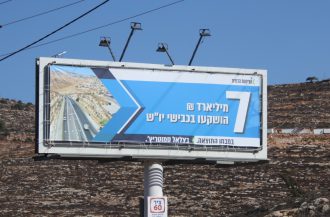
A billboard praising Minister Smotrich for investing NIS 7 Billions in West Bank roads
3. Coalition funds:
On March 10, 2026, the government approved coalition funds—funds that coalition parties allocate among themselves for purposes of their choosing, without criteria or a commitment to equality—totaling NIS 4.995 billion for 2026, 75% of which is directed to the ultra-Orthodox and national-religious sectors.
Within these coalition funds, the items clearly allocated to settlements are:
| Item | Amount (NIS) |
| Security grants to West Bank local authorities | 83,000,000 |
| Settlement Division | 100,242,000 |
| Security components in “young settlements.” | 50,000,000 |
| Assistance to local authorities in safeguarding Area C | 45,000,000 |
| Preventing damage to antiquities in the West Bank | 40,000,000 |
| Archaeology in the West Bank | 13,486,000 |
| Transportation – West Bank settlement education | 8,000,000 |
| Patriarchs’ tombs – support for the Cave of the Patriarchs | 2,193,000 |
| Maintenance of the Western Wall tunnels | 12,000,000 |
| Total | 353,921,000 |
NIS 50 million for farms and outposts —It should be noted that the budget line “security components in ‘young settlements'” (NIS 50 million) serves as a funding mechanism for establishing farms and unauthorized outposts in the West Bank. Over the past two years, the government has used these funds to finance violent farms, off-road vehicles, new roads, electric gates, solar panels and related infrastructure.
In previous years, even before the current government, coalition funds were also allocated to settlements for similar causes:
2023 – NIS 530 million
2024 – NIS 207 million
2025 – NIS 249 million
2026 – NIS 353.9 million
Total: NIS 1.340 billion
4. Settlement development expenditures — NIS 2 billion per year
Since the early 1990s, the Central Bureau of Statistics has calculated government expenditures unique to the settlements. In 2023, these expenditures amounted to NIS 2.012 billion. The calculation was introduced at the request of the U.S. administration in the 1990s and includes excess expenditures—those provided to settlements specifically for development and construction, or services provided solely by virtue of residents being settlers. Routine services provided to all citizens, including settlers, are not included in this calculation.
For example, the calculation includes government investment in all types of construction (infrastructure and residential, commercial, industrial, educational, and agricultural buildings), government investment in local roads within settlements, and targeted benefits and grants to local authorities in settlements.
The calculation does not include security expenditures, intercity roads, or routine services provided to settlers regardless of their place of residence (such as education, health, and welfare).
The Central Bureau of Statistics has not yet published data for 2024 and 2025. Based on an annual figure of about NIS 2 billion, it can be estimated that the Netanyahu government spent approximately NIS 6 billion on development and excess expenditures over the three years from 2023 to 2025.

Central Bureau of Statistics data on development expenditures in settlements
5. At least NIS 800 million for “civilian security reinforcement along the eastern border.”
On May 18, 2025, the cabinet (Decision B/189) approved a plan to strengthen settlement along Israel’s eastern border by establishing farms and educational institutions (such as pre-military academies and yeshivas) and by expanding existing communities. The plan applies to a 15-kilometer strip along the eastern border, from Eilat to the Sea of Galilee, including a significant portion of the West Bank.
The full text of the decision has not been made public. According to media reports, the cabinet appointed a team to prepare a detailed plan. In 2025, the government transferred NIS 80 million to the Ministry for Settlement Affairs, which passed the funds to the Settlement Division for an initial pilot program. In February 2026, the Settlement Division issued a call for proposals to establish farms and educational centers in line with the decision.
In the 2026 budget, the government allocated NIS 847 million to the Ministry for Settlement Affairs (as a multi-year commitment) for the plan. The funding is therefore already secured, even though its specific uses have not yet been determined.
The establishment of new communities not only harms the environment and sustainability but also places an additional burden on security rather than strengthening it. If there is a security threat along the eastern border, the IDF should be deployed along the border—not tasked with defending additional civilian sites. At a time when communities in the north and around Gaza urgently need rehabilitation and development, the government is instead investing in new settlements and outposts in the West Bank.
6. Settlement tourism projects — NIS 949 million
Since its establishment in December 2022, the Netanyahu government has adopted a series of decisions to fund tourism projects in the West Bank and East Jerusalem, as part of an effort to strengthen and deepen Israeli control in the West Bank and East Jerusalem.
| Decision Date | Subject | Amount (NIS) |
| 17/07/2023 | Plan for the rescue, preservation, and development of antiquities at heritage sites in the West Bank | 109,000,000 |
| 07/05/2023 | Rehabilitation of Sebastia | 32,000,000 |
| 21/05/2023 | Old City Basin Plan | 476,000,000 |
| 21/05/2023 | Shalem Plan (Silwan), Phase C | 41,000,000 |
| 05/06/2024 | Shalem Plan (Silwan), Phase D | 8,000,000 |
| 26/05/2025 | Shalem Plan (Silwan), Phase E | 18,500,000 |
| 24/12/2024 | Support for the Gandhi Heritage Center (West Bank) | 14,630,000 |
| 24/02/2026 | Cable car project | 250,000,000 |
| Total | 949,129,000 |
7. Security for settlers in East Jerusalem — NIS 489 million
Since the late 1980s, the Ministry of Housing has funded private security companies for settlers living in Palestinian neighborhoods in East Jerusalem. These companies escort settlers as they walk in the street and guard their homes around the clock.
In practice, the budget for settler security in East Jerusalem is effectively controlled by the settlers themselves. Each year, settlers take over additional homes and compounds in Palestinian neighborhoods, and the Ministry of Housing is then required to fund security for these new sites. As a result, the security budget continues to grow and expand without any formal government decision or directive, but rather in response to facts created on the ground by settlers.
The budget for private security in East Jerusalem was:
2023 – NIS 107 million (actual expenditure)
2024 – NIS 101 million (actual expenditure)
2025 – NIS 128 million (approved budget)
2026 – approximately NIS 153 million (draft 2026 budget)
Total: NIS 489 million
It should be noted that approximately 3,500–4,000 settlers live in Palestinian neighborhoods in East Jerusalem. This amounts to a cost of roughly NIS 3,000 per month per settler.

* Not including the multi-year commitment budget