*** Update as of 30/6/26: The Israel Land Authority has published an announcement with new dates for the tender for the employment zone and for the tender for the construction of 3,401 housing units in E1. According to the updated schedule, the tender for the construction of the neighborhood will open for bids on 5/8/26, with the final submission deadline set for 5/10/26; the tender for the employment zone will open for bids on 20/7/26 and will close on 14/9/26. ***
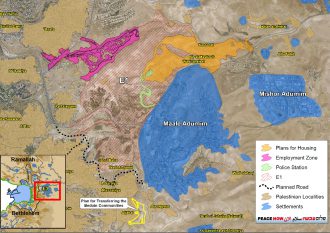
Quietly, away from public attention, the Israel Land Authority published about two months ago a tender for the construction of a new employment and commercial zone in the E1 area. The planned employment zone covers 1,355 dunams east of Anata and a-Za’ayyem, to the east of Jerusalem, and access to it is planned from the direction of Jerusalem. In this way, the government is completing the linkage between Ma’ale Adumim and Jerusalem through construction in E1. The tender joins the tender for the construction of 3,401 housing units in E1 that was published in December and is expected to open for bids in early June.
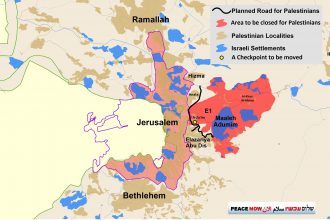
At the same time, a new building plan was published for deposit near the landfill in Abu Dis, intended to enable the displacement of dozens of Bedouin communities living in the E1 area. Alongside the plan to build a new settlement in E1, the government is also advancing the paving of a new road for Palestinians that will divert Palestinian traffic away from the area and enable the closure of a vast area—about 3% of the West Bank—to Palestinians.
Peace Now: What violent settlers are doing through terror and violence, the government is doing through plans and roads. The government’s goal is to take final and absolute control over the heart of the West Bank and to remove any Palestinian presence from it. This is a fatal blow not only to the possibility of establishing a Palestinian state alongside Israel, but even to the development of a functioning Palestinian economy without a state. These steps could bring about the elimination of the possibility of ending the conflict and achieving a two-state agreement. The Netanyahu government is condemning us to the continuation of the conflict, violence, and bloodshed, and to the destruction of the State of Israel.
The Plans for the E1 Area
1. Employment Zone
The planned employment zone is based on Plan No. 240/4/2, which was approved for validation 24 years ago, in July 2002, at the height of the Second Intifada. Since it is a plan for employment rather than housing, it did not attract much public attention, even though its construction would amount to the establishment of an Israeli settlement in every respect. The tender, published on March 5, 2026, on the Israel Land Authority website, is expected to open for bids in the coming days and close on June 29, 2026. If the tender proceeds without delays, construction of the employment zone could begin within about a year after the tender closes and the winners are selected.
Access to the employment zone is intended to be from the west, from the direction of Jerusalem. In this way, the employment zone will serve as a connecting link between Jerusalem to the west, through the E1 settlement, to Ma’ale Adumim in the east. The Israeli territorial continuity that Israel seeks to create will prevent the natural development of Palestinian territorial continuity from north to south in the West Bank and will stifle the development of Palestinian East Jerusalem.
2. Settlement of 3,401 Housing Units and an Investment of NIS 3 Billion
The central plans for E1 are the residential plans No. 420/4/7 and 420/4/10, which received final approval last August. In September 2025, Prime Minister Netanyahu signed a development agreement for the Ma’ale Adumim settlement, under which the government committed to allocating NIS 3 billion for infrastructure development in Ma’ale Adumim and E1, enabling the acceleration of the plans’ implementation.
Several petitions against the approval of the plan were filed in the District Court by Palestinian residents who would be harmed by the plans, as well as by Israeli organizations such as Ir Amim, Peace Now, and Bimkom. The court denied the petitioners’ request to freeze construction progress while the petition is being reviewed. Consequently, the Israel Land Authority moved quickly, launching a tender in December 2025 to build all planned housing units. The hearing for the petitions has been set for June 15, 2026. The opening of the tender was postponed to June 1, 2026, and it is expected to close for bids on July 6, 2026.
At the same time, the Ministry of Housing and the Ma’ale Adumim municipality continue to prepare additional construction plans for the E1 area.
For more on the plan and its implications – see here.
3. A New Road That Will Close the Entire Area to Palestinians
In January 2026, the Ministry of Defense announced its intention to soon begin paving a new road, at a cost of NIS 335 million, that will divert all Palestinian vehicle traffic away from the current road that passes between Ma’ale Adumim and E1. Once the new road is paved, the existing road will be closed to Palestinians, effectively sealing off the entire E1 area—which constitutes about 3% of the West Bank—from Palestinian access. The closure of the area would be a fatal blow to dozens of Palestinian Bedouin communities, such as Khan al-Ahmar and others, that reside in the area.
Last Monday (May 11, 2026) the Civil Administration demolished dozens of Palestinian shops at the entrance to the town of Al-Eizariya. The shops were located on land that forms part of the route for the planned new road, and the demolition was apparently carried out as part of preparations to begin paving.
For more on the planned road – click here.
4. Plan to Concentrate and Displace Palestinian Communities
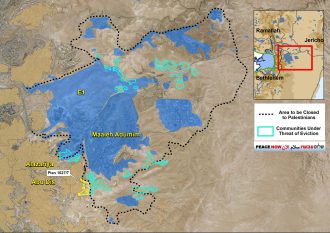
About a month ago, Plan No. 1627/7 for the expansion of the al-Jabal neighborhood in Abu Dis was published for deposit. The al-Jabal neighborhood was established in the 1990s for the Jahalin community, which was displaced by Israel to enable the expansion of the Ma’ale Adumim settlement. At that time, the Supreme Court ruled that the government may not expel a community without providing its residents with an alternative place to live. Therefore, the government allocated several dozen dunams on the outskirts of Abu Dis, near the large landfill serving Jerusalem and its surroundings—where millions of tons of waste have been buried—for the Palestinian residents displaced from the Ma’ale Adumim expansion area. The forced transfer of the Jahalin community was devastating for the community, especially for the women.
The new plan is a government-initiated plan that designates about 79 dunams for residential use at a density of up to 12 housing units per dunam (up to 950 housing units; however, the land has a steep slope, the buildings are multi-story and not suited to the lifestyle of Bedouin communities, and in practice only some of the units are likely to be realized). The plan is located less than 100 meters from the Abu Dis landfill.
The publication of a plan for deposit is one of the advanced stages in the planning approval process. Advancing the plan at this time is part of the government’s preparations to close off the area to Palestinians and enable the displacement of communities. The government is preparing for a petition to the High Court of Justice that residents are expected to file against the closure of the area and their expulsion from their homes. With an approved plan in place, the government will argue before the Court that residents have an alternative place to go, and the justices may approve the displacement, as was done in the past in the case of the Jahalin community and the expansion of Ma’ale Adumim.
For more on the plan to displace Palestinian communities – click here.
5. Highway Network from Israel to E1
The settlements in the E1 area and Ma’ale Adumim (like all settlements) are based on the Israeli economy. Most settlers in Ma’ale Adumim work in Jerusalem and commute daily to and from the city. To attract tens of thousands of Israelis to live in the settlement in E1, the government is also working on a network of highways that will enable daily commuting. The road designated for Palestinians is intended to allow the removal of the checkpoint between Ma’ale Adumim and Jerusalem and to save hours of daily waiting in security lines.
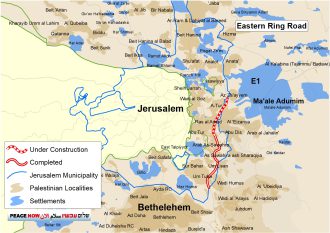
About two years ago, the French Hill tunnel was opened to traffic, enabling rapid travel from the direction of Ma’ale Adumim to northern Jerusalem and Tel Aviv. The government is now investing about NIS 1.5 billion in excavating the Sheikh Inbar tunnel, approximately 1.5 km long, beneath the Palestinian neighborhood of a-Tour, as part of the Eastern Ring Road (sometimes referred to as the “American Road North”). This road will enable Ma’ale Adumim to be connected via a high-speed, signal-free route to southern Jerusalem.
At the same time, the Ministry of Transport is currently advancing the construction of the Issawiya interchange and has contracted the Moriah Company to carry out the project. The interchange will eliminate the traffic light at the junction between Issawiya and the road that will lead to the employment area in E1.