

*** 19/4/2026 update: The Supreme Court partially granted the Basha Family’s request and postpone the eviction date to May 26, 2026 ***
The General Custodian at Israel’s Ministry of Justice has filed an eviction lawsuit against 12 elderly Palestinians from the Basha family, who have lived since the 1930s in a three-story building in the Old City of Jerusalem. According to the General Custodian, the property belongs to a Jewish religious endowment that operated the Torat Chaim Yeshiva in the early 20th century.
Members of the Basha family have resided in the building since the 1930s under an agreement with the yeshiva. Throughout their lives—including after 1967—no one challenged their rights to the property, not even the General Custodian, who only filed the lawsuit in 2018, 50 years after assuming responsibility for managing Jewish-owned properties in East Jerusalem.
On March 2, 2025, Judge Bilhah Yahalom of the Jerusalem Magistrate’s Court accepted the claim and ordered the building’s eviction. The Jerusalem District Court later rejected the family’s appeal, and in December 2025, the Supreme Court also denied leave to appeal. The Court ruled that the Basha family must vacate their home by April 26, 2026, in favor of Ateret Cohanim settlers.
Peace Now: “This is an injustice that cries out to heaven. While hundreds of thousands of Israelis live securely in properties that belonged to Palestinians before 1948, the law in East Jerusalem allows Palestinians to be dispossessed of homes that belonged to Jews before 1948. The government has established a mechanism for the dispossession and expulsion of Palestinians in East Jerusalem, and the General Custodian, a governmental body, has become a central executive arm of this policy.
In addition to dozens of eviction lawsuits filed in recent years against Palestinians, the Custodian has also initiated and advanced plans for new settlements within Palestinian neighborhoods in Jerusalem.”

Mufid Basha at his home in the Old City, April 2026
They Guarded the Yeshiva and Its Assets—Now They Are Being Evicted
Mufid Basha was born in the Old City in 1950 in the same home where he still resides and where he raised his three children. His father, Muhammad Basha, served as the guard of the Torat Chaim Yeshiva, which operated in two buildings in the Old City in the early 20th century. In return for safeguarding the yeshiva and its members, Muhammad Basha and his father received a monthly salary and housing within the compound.
In the 1940s, the Basha family purchased parts of the yeshiva’s buildings. As 1948 approached and the yeshiva could no longer operate in the Old City, it leased the entire compound to the family under a rental agreement.
At the end of the 1948 war, the Old City remained under Jordanian rule.
“My father did not allow anyone to enter the compound and loot the yeshiva,” Mufid Basha recounted. “He locked all the books, furniture, and sacred items in one room and safeguarded them for years, even though he did not know if or when he would be able to return them.”
“In 1967, when Israel captured the Old City, my father returned everything to the yeshiva. Newspapers even reported on it.”
When president Chaim Herzog, who served as the first military governor of the West Bank in 1967, was asked what had moved him most in his role, he replied:
“I was deeply moved when I heard about an elderly Arab who had safeguarded in his attic the thousands of books belonging to the Torat Chaim Yeshiva and had not allowed anyone to touch them.” (Raphael Bashan, Maariv, July 7, 1967.)
After 1967, a synagogue began operating in the yeshiva building alongside the apartments of Palestinian families. In 1983, the Ateret Jerusalem Yeshiva of the Ateret Cohanim organization began operating there.
Thanks to the Basha family, Torat Chaim is the only yeshiva among dozens of yeshivot and synagogues that operated in the Old City before 1948 whose equipment was preserved and not looted. Yet today, members of Ateret Cohanim, with the assistance of the General Custodian, are seeking to evict the family from its home.
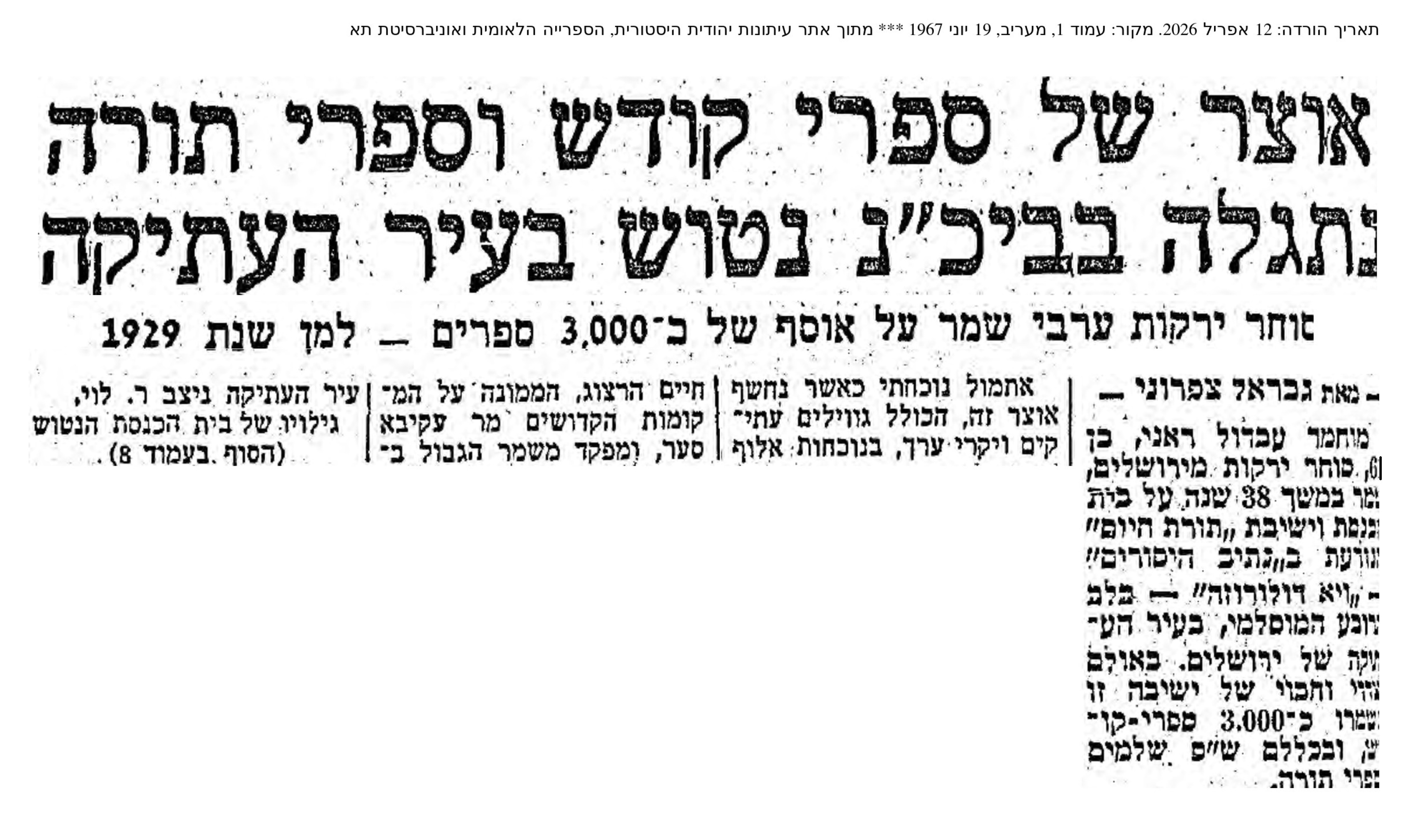
Maariv newspaper on the safekeeping of the yeshiva’s books and properties by Mofid’s father, June 1967
The Legal Basis: A Law for Jews Only
The lawsuit is based on the Legal and Administrative Matters Law, enacted by the Knesset in the 1970s. Under this law, properties in East Jerusalem that were owned by Jews prior to 1948 can be restored to their owners, while another law denies such rights to Palestinians who lost property in West Jerusalem and elsewhere in Israel in 1948 (see: One city, two laws).
Over the years, Israeli authorities have applied this law not only to vacant properties and open land but also to facilitate the eviction of Palestinians from their homes in favor of settlers. However, unlike similar cases in the past, the lawsuit in this instance was not filed by settlers who acquired ownership rights from heirs, but by the General Custodian himself.
As a governmental body, the General Custodian enjoys procedural advantages in court and used his public authority to persuade the judiciary to accept the claim.

The entrance to the Torat Hayim Yeshiva Building, al-Wad St. in the Old City
The Conduct of the General Custodian
The General Custodian, a governmental body within the Ministry of Justice, is responsible, among other duties, for managing properties in East Jerusalem that were owned by Jews prior to 1948. These properties were administered by the Jordanian Custodian of Enemy Property until 1967. The Jordanian authorities preserved Jewish ownership and used the properties only for public purposes and for leasing to Palestinian tenants—unlike Israel, which transferred ownership of Palestinian refugee properties to third parties.
After 1967, the General Custodian continued the lease agreements with Palestinian tenants, collected rent, and managed the properties. When original owners or their heirs requested it, the Custodian released the properties to them in accordance with the law.
Over the years, settler organizations leveraged this system to obtain control of numerous properties through legal heirs, subsequently filing eviction lawsuits against Palestinian residents. In many cases, these efforts resulted in dispossession and the establishment of settlements in their place, including in Sheikh Jarrah, the Old City, and Batan al-Hawa.
In recent years, however, the General Custodian has become a central instrument in the dispossession of Palestinians in East Jerusalem. The Custodian has begun filing eviction lawsuits directly while also initiating and promoting settlement construction plans in Palestinian neighborhoods, including in Abu Dis (“Kidmat Zion”), Umm Lison, Umm Tuba (“Nofei Rachel”), Beit Safafa (“Givat Shaked”), and Sheikh Jarrah (“Nahalat Shimon”).
This shift coincided with the 2017 appointment of Hananel Gurfinkel, an activist advocating the Judaization of East Jerusalem, to oversee these properties within the General Custodian’s office. Around the same time, the Custodian hired attorney Avi Segal—who represents the settler organizations Elad and Ateret Cohanim—to file at least 11 eviction lawsuits against Palestinians, including the case against the Basha family.
Bad Faith in the Conduct of the General Custodian
The conduct of the General Custodian in the lawsuit against the Basha family is marked by bad faith and an abuse of his status as a governmental authority. First, the Custodian filed the eviction claim despite already being in contact with representatives of the yeshiva regarding the release of the property, and continued to pursue the case even after releasing the property in 2020. From the moment the property was released, the General Custodian no longer had connection to it, yet he nevertheless persisted with the eviction proceedings.
Moreover, the Custodian retained attorney Avi Segal, who also represents Ateret Cohanim—the beneficiary of the property—creating an alleged conflict of interest.
The Custodian also acted after an extensive delay. For more than 50 years, from 1967 until 2018, the Basha family lived in the building under a lease agreement dating back to the 1940s, without challenge. Documents submitted by the Custodian reveal that by 1979 he had already visited the property, knew of its existence, and received a request from the yeshiva to release it. Yet, unlike other Jewish-owned properties in East Jerusalem, he neither collected rent nor took action in this case.
By the time the lawsuit was filed, the original signatories to the agreements were no longer alive, leaving six elderly couples—born in the building and never required to prove their rights—to face eviction.
The Custodian’s involvement also had decisive legal implications regarding the statute of limitations. Israeli law provides that, in certain circumstances, eviction claims cannot be filed more than 15 years after an alleged trespass. However, the Supreme Court has ruled that this limitation does not apply when the property is administered by a public body such as the General Custodian. Had the lawsuit been filed by the yeshiva, the claim might have been dismissed on limitation grounds.
Concealment of the Lease Agreement
At the time the lawsuit was filed, the members of the Basha family who had signed the original lease agreements and purchased parts of the building in the 1940s were no longer alive. The last of them, Mufid’s father Muhammad Basha—who signed the 1931 guardianship agreement—died in 1990.
While the General Custodian presented numerous documents to prove the yeshiva’s ownership, he concealed the existence of a lease agreement between the yeshiva and the Basha family. The family learned of the lease only from a document submitted by the Custodian documenting a 1979 visit to the property, which stated that the family held rights of tenancy and subletting.
This lease significantly alters the legal picture and may explain why the General Custodian refrained from acting regarding the property for decades. However, by the time the information came to light, it was too late for the family to amend its legal arguments in court.