

Large forces of police and enforcement officers raided the Baten Al-Hawa neighborhood in Silwan this morning and evicted two buildings from their Palestinian residents. The house of the Yousef Basbous family, with four apartments and 21 residents, and the house of the Ya’akov Rajabi family with 11 apartments and 44 residents. The evictions were carried out after the court accepted the settlers’ claims, who claimed rights based on the rights of a Jewish endowment that operated in the area a century ago. The courts did not deny the Palestinians’ rights to their homes, and in some cases even explicitly ruled that they had been legally purchased by them, but they ruled that the ownership of the Jewish endowment from the late 19th century outweighed the Palestinians’ ownership and justified their eviction.
Yosef Basbous, whose family was expelled from their home in Silwan today: “Our family was expelled in 1948 and dispersed in refugee camps in the West Bank. I arrived in Silwan with my parents more than 60 years ago, I built this house stone by stone, brick by brick, nail by nail. Today they come to us and expel us again. They claim that the land belonged to a Yemeni waqf and that the custodian sold the land to settlers. The police say they are implementing the court’s decisions, according to the law. But what kind of law is this that can expel me, who have been here for more than 60 years.”
Peace Now: “Unfortunately, there is no other word to describe this than ethnic cleansing. Settlers, with the help of the government and a discriminatory legal system, are expelling an entire Palestinian community and replacing it with settlers. This is happening in the Jerusalem of 2026 and it is a stain that will not be erased from Israel.”
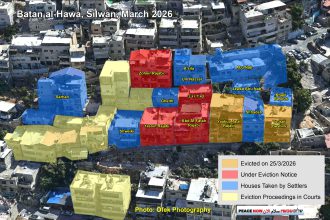
Current snapshot (March 2026): Around 60 families are at risk of eviction:
Already evicted from their homes:
37 families with hundreds of people have already been evicted, and settlers have moved in in their place, including seven homes that settlers entered in the past two years: the Shhadeh family home, the Abu Nab family home, the Gheith family home, the Odeh and Shuweiki families’ home, the Umm Nasser Rajabi family home, the Khalil Basbous family home and today the Yousef Basbous and the Yaakub Rajabi families’ homes.
Ongoing Lawsuits in the Magistrate’s Court:
There are at least four additional eviction lawsuits that we know of against at least 12 homes, involving dozens of families and hundreds of residents. These cases are at various stages in the Jerusalem Magistrate’s Court before different judges (families including Odeh, Abu Ramouz, Duweik, and Sarhan).
One Law for Israelis; Another one for Palestinians
The basis for all the lawsuits is the same: the Legal and Administrative Matters Law enacted in 1970 by the Knesset stated that Jews who owned property in East Jerusalem and lost it in 1948 can receive it back from the Israeli General Custodian, even though all those Jewish property owners received alternative homes from the state as early as 1948. This is in contrast to the Absentees’ Properties Law from 1950, which states that Palestinians who lost their property in Israel in 1948 and became refugees would not be entitled to receive it back. Since the Legal and Administrative Matters Law was applied only in East Jerusalem and not in West Jerusalem, it only applies to Jews and not to Palestinians who lost their property in the same war and under similar circumstances.
For more information on the Legal and Administrative Matters Law – see One City, Two Laws, and also here.
International law prohibits the evacuation
In the advisory opinion of the International Court of Justice (ICJ) given last July, the court specifically referred to the Israeli settlement policy in East Jerusalem and the discriminatory system of laws, in particular the Absentees’ Properties Law, which results in the eviction of Palestinians from their homes in favor of settlers. The court ruled that this policy constitutes a violation of international law (see for example paragraphs 119, 122, 163, 196 of the opinion).
In one of the Batan al-Hawa lawsuits that reached the Supreme Court, a group of leading Israeli experts in international law filed an application with the court to submit an amicus curiae brief. According to the brief, Palestinian residents’ human right to housing includes the right to continue living in properties that have served as their homes for decades, and they have developed certain property rights in these homes. The brief addresses an approach that has emerged in international human rights jurisprudence, which emphasizes the group vulnerability of occupants facing eviction and institutional, systemic discrimination. Where these are present, in certain circumstances, the occupants’ rights, stemming from the human right to housing and specifically, to live in their home and their family’s home, trump the right of the original owner or their substitute to regain possession of the property.
Much of international law applies fully and directly in Israel and constitutes an integral part of the domestic local legal system. In addition, the courts must interpret Israeli law, to the extent possible, in a manner consistent with international law, even without direct application (we note that the brief does not address international criminal law or the laws of war). So far, all deliberations in cases concerning evictions in Sheikh Jarrah and Batan al-Hawa have focused on questions arising from private law (property, charitable endowments, limitations, protected tenancy, etc.), as if the parties were equal sides in a real estate dispute.
The brief provides a new perspective, uncovering the full picture and the context for the eviction applications: The Palestinian family in question belongs to a vulnerable, discriminated group, both in terms of legal rights and in terms of policy and resources. They are facing an orchestrated effort, with state backing, to dispossess them of their homes. The family entered the properties lawfully (they are not trespassers) and have lived in the houses for generations, in some cases for more than 60 years. In such circumstances, under international human rights law, families have a right to the property where they live, and, if certain conditions are met, that right overrides the original owners’ right to regain possession. Many examples of such cases from around the world are available.
The court read the brief but did not refer to it in its decision. The court returned the discussion of the question of ownership for another discussion at the Magistrate’s Court.
For more on the opinion from international law, see here.
The matter is not legal but political; the government can stop the eviction
The settlers have an interest in presenting the issue as a purely legal matter, of two parties arguing over ownership of the property and the court deciding. But denial and blindfolding are needed to ignore the context and mechanism established to exploit discriminatory laws for the purpose of realizing settlement political goals. This is a political issue with far-reaching implications for the entire State of Israel and the future of the conflict, and the court is only the tool to implement the move. Therefore, the Israeli government has a responsibility and an obligation to intervene.
1. To express a legal position in the Batan Alhawa cases – Although Justice Sohlberg decided not to wait any longer for the State’s position, the government can still express a legal position in the pending cases, according to which the residents of Batan Al-Hawa have rights to continue to live in their homes even though the official ownership belongs to settlers. This position can be based, for example, on international law, which is part of the system of legal considerations in Israel – see the legal opinion submitted on the matter.
2. The government can expropriate the land – the government can expropriate the land for public purposes (while compensating the settlers). Since 1967, the Israeli government has expropriated about a third of East Jerusalem lands to build 55,000 housing units for Israelis. What was done for the benefit of the Israeli public with the expropriation of more than 20,000 dunams from Palestinians, can be done for the benefit of the Palestinian residents of Batan Al-Hawa with the expropriation of 5 dunams from settlers.
3. Change in legislation and policy – the Knesset can correct the injustice caused as a result of the discriminatory law by amending or repealing the relevant sections of the Legal and Administrative Matters Law (1970) on the basis of which all these eviction claims were filed.
4. The immediate way to prevent eviction is to avoid sending the police to assist in evacuation. Without the police, people cannot be evicted from their homes. It is the police who determine the appropriate timing for carrying out various tasks in accordance with the security situation and considerations of public peace. The police can determine that for now, for reasons of security and public safety, the evacuation should be avoided. Such a position has been taken in the past and obtained the approval of the Attorney General (in 1991 when the police prevented the Elad settlers from entering houses in Silwan, and in 1999 in an Attorney General opinion on a property in Ras Al-Amoud). see more here.