

According to media reports, Israel’s security cabinet decided on Thursday, Dec. 11, 2025, to establish 19 new settlements in the West Bank. Some of the settlements are slated for areas where Israel has not previously had a presence, while others would be built in densely populated Palestinian areas. Several of the planned settlements are expected to be built in the northern West Bank, on the sites of settlements that were evacuated under the 2005 disengagement plan. In several cases, the new settlements are expected to be established on sites from which Palestinian communities were expelled.
Last week’s cabinet decision adds to a series of earlier decisions by the Netanyahu–Smotrich government to establish new settlements. Over the past three years, the government has decided to establish 49 settlements. The latest decision brings the total to 68 new settlements for the 2023–2025 period. On the eve of the government’s formation, about 141 officially recognized settlements were operating in the West Bank, built over 55 years. Implementing the government’s decisions would increase that number by nearly 50 percent.
Peace Now: “The government is doing everything it can to entrench Israel’s presence in the territories and to foreclose the possibility of a future of peace and two states for two peoples. Establishing settlements in areas where Israel has not previously had a presence is intended to sever Palestinian territorial continuity and to destroy what little economic development remains possible for Palestinians. The government’s policy is not only immoral, but also a security and economic folly that will further worsen Israel’s situation.”
It is important to note that such a decision has far-reaching implications: Legally and politically, it is far more difficult to evacuate a settlement established by a government decision than to remove an outpost built without official authorization. The decision to establish the settlements was made by Israel’s security cabinet, whose deliberations and decisions are confidential, rather than by the whole cabinet, whose decisions are made public. As a result, the precise locations of all the planned settlements are not yet known. According to information available to us and to media reports, the following settlements and outposts were approved, along with their locations:
Kida — the retroactive authorization of an outpost west of the Palestinian village of Duma, in the Nablus district.
Esh Kodesh — the retroactive authorization of an outpost south of the villages of Jalud and Qusra and west of Duma, in the Nablus district.
Givat Harel — a split from the settlement of Givat Haroeh, which was approved in 2023. The settlement is located between the villages of Sinjil and Lubban al-Sharqiya, in the Nablus district.
Mishuol — likely east of the settlement of Naaleh, between the villages of Ras Karkar and Deir Ammar, west of Ramallah; it may be at the site of the Shalom Farm outpost.
Reihanit — likely in the northwestern West Bank, near the settlement of Reihan and the area of the village of Ya’bad.
Rosh HaAyin East — likely in the area of the Shirat David farm, established a few months ago between the villages of Zawiya and Deir Ballut, in the Salfit district.
Pnei Kedem — an outpost in the Mount K’nuv area, east of the Palestinian town of Sa’ir, near the settlement of Mezad (Asfar) in the southeastern Etzion Bloc. In recent years, it was retroactively authorized as a “neighborhood” of Asfar, and it will now become an independent settlement.
Yatziv (Shadma) — an outpost established in November on the grounds of a military base, adjacent to the Palestinian town of Beit Sahour, in the Bethlehem district.
Ya’ar al-Keren — likely between Beit Ummar and the Al-‘Arrub refugee camp, south of Bethlehem.
Allenby — it may be near the Allenby checkpoint in the Jordan Valley, in the Jericho district.
Kokhav Hashahar North — likely at the site of the Nahalat Ephraim farm, east of Ein Samia.
Nof Gilad — there is a farm by that name in the Umm Zuqa reserve in the Jordan Valley. Still, it may refer to the Netzach Harel farm, near the Bedouin communities in Al-Mu‘arrajat, between Taybeh and Jericho.
Yitav West — it may refer to the area of the Auja farm, near the Bedouin community of Ras al-‘Ain, which faces frequent threats and is at risk of expulsion.
Bezek — at the site of the Bezek farm, also known as Har Bezek 713, the highest peak between the Jordan Valley and the hills of the Jenin area.
Tamun — likely on one of the hills near the Palestinian village of Tamun, between the Jordan Valley and the Nablus area.
Shalem — near Beit Dajan and Beit Furik; a farm called “Derech Avraham” currently operates at the site.
Nahal Doran — an uninhabited area between the settlements of Shima and Adoraim, west of Dura.
Ganim — a settlement evacuated under the 2005 disengagement plan, east of Jenin.
Kadim — a settlement evacuated under the 2005 disengagement plan, east of Jenin.
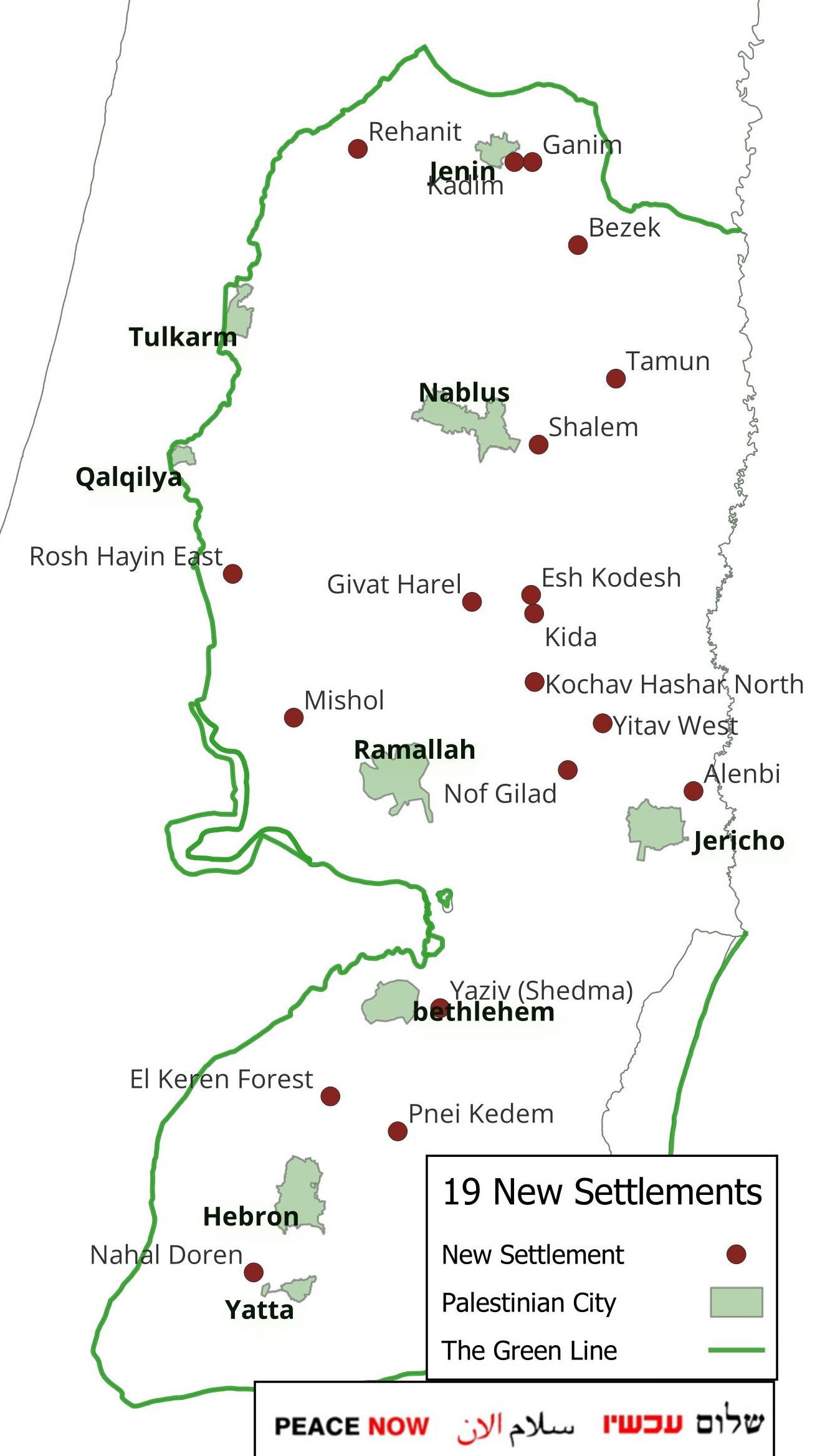
The decision to establish two new settlements in the northern West Bank, Kadim and Ganim, follows a May 2025 decision to advance the settlement of Sa-Nur and the establishment of the Homesh outpost in 2023. The establishment of these settlements has been made possible by a change to the disengagement law that again permits an Israeli presence in an area that had previously been off-limits to Israelis.
In several cases, the new settlements are expected to be established on sites from which Palestinian communities were expelled (Kokhav Hashahar North — Ein Samia; Nof Gilad — Mu‘arrajat; Meshuol — Arab al-Jahalin; Ein Ayyub), or near communities that are currently at risk of expulsion (Yitav West — Ras al -‘Ain). These cases suggest that the Israeli government is using settler violence with a clear aim to push out Palestinian herding communities.