

Yesterday, the Civil Administration’s Government Property Custodian declared 465.4 dunams (115.2 acres) of land of the villages of Sinjil and Luban a-Sharqiya, as “state land,” in order to legalize the illegal outpost of Haroeh. While the built-up area of the outpost covers approximately 100 dunams, the declaration includes an area 4.5 times larger, which will allow for the future expansion of the outpost.
In February 2023, the cabinet decided to legalize the outpost as an independent settlement. Now, as part of the legalization process, the state is declaring the lands as “state land” so that the land can be allocated for planning and later for construction. The landowners are given 45 days to file objections to the declaration and attempt to prove that the land belongs to them.
Since the current government was established in December 2022, approximately 27,119 dunams have been declared state land — an amount nearly equal to all the land declared state land since the Oslo Accords. The declaration of state land is one of Israel’s main methods of taking control of land in the occupied territories. Land declared as state land is no longer considered by Israel to be privately owned Palestinian land, and Palestinians are prevented from using it. At the same time, the state allocates state lands exclusively to Israelis.
During the 1980s, Israel declared hundreds of thousands of dunams as state land. The Rabin government decided in 1992 to halt state land declarations in the territories, but the Netanyahu government resumed the use of this method in 1998. Since the establishment of the current government, there has been a sharp increase in the amount of land declared as state land, and the government intends to carry out additional declarations in order to establish new settlements approved by the cabinet.
Peace Now: “Netanyahu and Smotrich are determined to fight against the entire world and against the interests of Israel’s residents for the benefit of a small group of settlers who receive thousands of dunams as a gift, as if there is no political conflict to resolve. They are exploiting every moment in power to create more and more facts on the ground that will make it harder for Israel to reach peace. Today it is clear to everyone that this conflict cannot be resolved without a political agreement that includes the establishment of a Palestinian state in the West Bank, yet the Israeli government is choosing instead to make this possibility more difficult and move us further away from peace and from ending the bloodshed.”
For more information about the state land declaration process — see here.
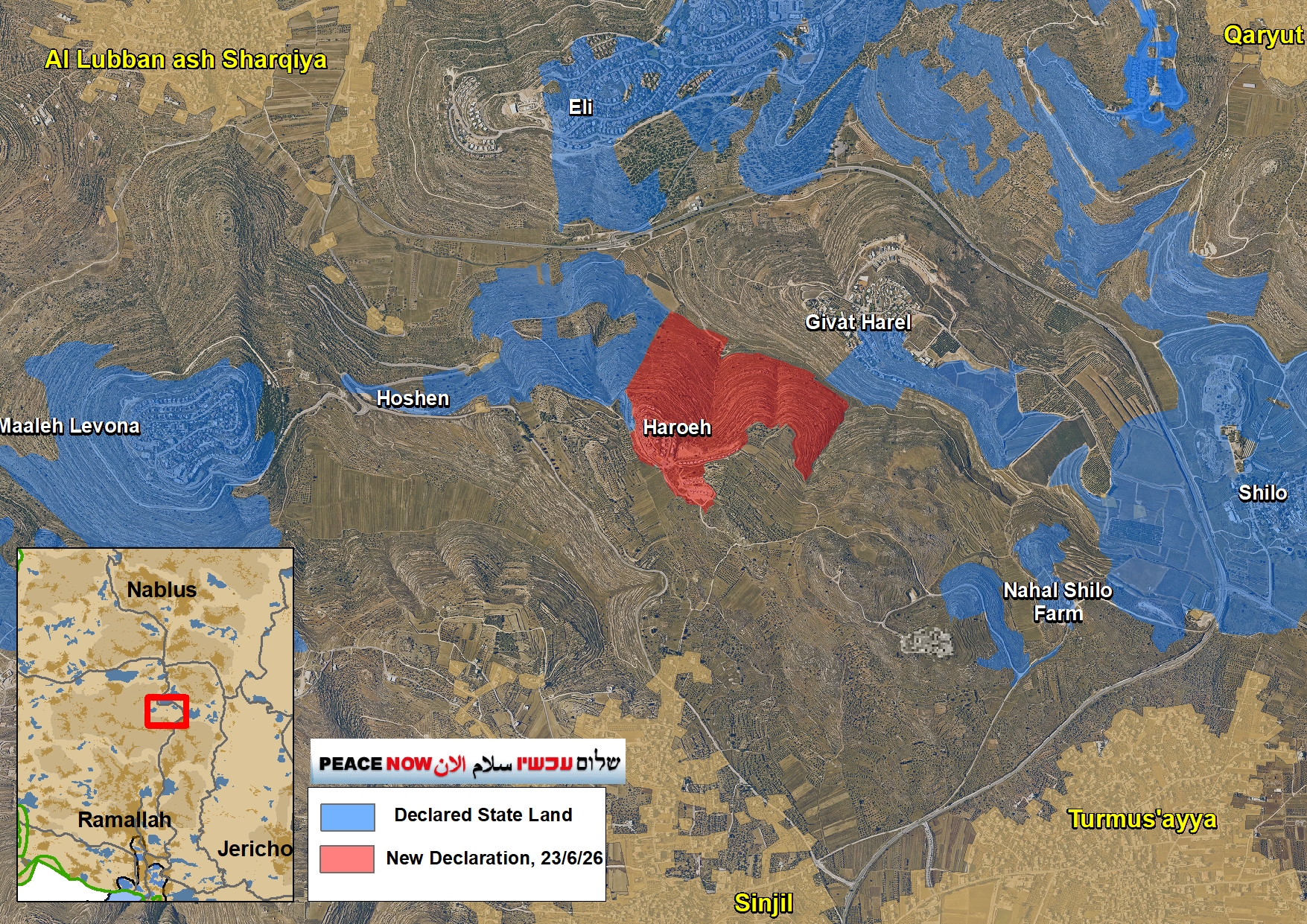
Legalization of the Haroeh Outpost – Crime Pays
According to international law, all settlements are illegal. However, according to the rules established by the State of Israel in the occupied territories, settlements can be established through a “legal” process that includes a government decision to establish the settlement, allocation of land, planning, and the issuance of building permits.
The Haroeh outpost was established in 2002 on “survey land” (land that the state believed could potentially be declared state land because it was not being intensively cultivated). Immediately after its establishment, demolition orders were issued against it, and the government even issued a “delimitation order” requiring the evacuation of the outpost regardless of the legal status of the structures.
However, the orders were not enforced. In 2007, Peace Now petitioned the High Court of Justice demanding implementation of the delimitation orders issued against the Haroeh outpost and five additional outposts. The legal proceedings lasted many years, during which the state announced that it intended to legalize the outpost. In 2014, the court decided not to require the state to evacuate the outpost and allowed it to regularize its status through a legal process.
Three years later, in 2017, the Government Property Custodian declared lands adjacent to the outpost as “state land.” The declaration did not include the areas on which the homes had been built, meaning that the outpost could not be legalized. At the same time, a major construction project began at the outpost. Peace Now received testimony regarding the involvement of the Binyamin Regional Council in the illegal construction at the outpost and filed a police complaint regarding this involvement.
However, the police did not open an investigation. In 2021, Peace Now petitioned the High Court of Justice demanding that the police be required to investigate the council’s involvement in illegal construction at the Haroeh outpost. In February 2025, after years of delays by the state, the Supreme Court accepted the petition and ordered the police to open an investigation. As of the writing of this statement, the police have not yet provided Peace Now with information regarding the progress of the investigation.
Now, the government is working to legalize the illegal outpost, once again proving that the strategy of creating facts on the ground — in violation of the law and government decisions — pays off.
Download the list of declarations by Peace Now, 23/12/24.
Download the list of declarations at the Civil Administrations reply to Peace Now's Freedom of Information request, December 2016.