About two month ago, Plan No. 1627/7 for the expansion of the al-Jabal neighborhood in Abu Dis was published for deposit. The al-Jabal neighborhood is a community that was established in the 1990s for the Jahalin Bedouin community, which was displaced by Israel in order to enable the expansion of the Ma’ale Adumim settlement. At that time, the Supreme Court ruled that the government may not expel a community without providing its residents with an alternative place to live. Therefore, the government allocated an area of several dozen dunams on the outskirts of Abu Dis, near the large landfill that serves Jerusalem and its surroundings—where millions of tons of waste are buried—for the Palestinian residents who were displaced from the Ma’ale Adumim expansion area. The forced transfer of the Jahalin community was devastating for the community, and especially for the women within it.
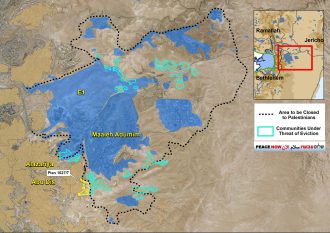
The new plan now being advanced by the government constitutes an important component of the government’s broader plan to take control of the area east of Jerusalem and to expel the Palestinian residents from it. Over the past year, the government approved the construction plan in the E1 area and even issued tenders for its implementation, and it has announced its intention to soon begin paving a road that would enable the closure of a vast area—approximately 3% of the West Bank—to Palestinians.
Peace Now: What violent settlers are doing through terror and violence, the government is doing through plans and roads. Both are aimed at expelling Palestinians from their homes and lands and taking control of the territory. It is no coincidence that the government is investing so many resources in the E1 area. Israeli control over this area in the heart of the West Bank would effectively prevent any possibility of a two-state political agreement and would deal a severe blow to the ability to develop a viable Palestinian economy.
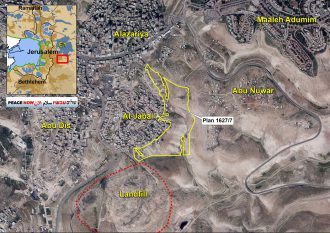
Plan No. 1627/7 for the expansion of the al-Jabal neighborhood is a government-initiated plan. The plan designates approximately 79 dunams for residential use, at a density of up to 12 housing units per dunam (up to approximately 950 housing units in total, in multi-story buildings that are not suited to the lifestyle of Bedouin communities; on a steep slope that makes construction highly challenging; in practice, it is likely that only some of the planned housing units will be realized). The plan is located less than 100 meters from the Abu Dis landfill, where millions of tons of waste from Jerusalem have been buried over decades.
The publication of a plan for deposit is one of the advanced stages in the planning approval process. Following publication, the public is given the opportunity to submit objections and reservations to the plan within 60 days. After objections are submitted, the Higher Planning Council convenes to hear the objectors and then decides whether to approve the plan for validation, reject it, or introduce modifications. Once the plan is approved for validation, building permits may be issued and construction can begin. The Palestinian communities are currently working on filing an objection to the plan.
Advancing the plan at this time is part of the government’s preparations to close off the area to Palestinians, which would lead to the displacement of communities. The government is preparing for a petition to the High Court of Justice that residents are expected to file against the closure of the area and their expulsion from their homes. With an approved plan in place, the government will argue before the Court that residents have an alternative place to go, and the justices may approve the displacement, as was done in the past in the case of the Jahalin community and the expansion of Ma’ale Adumim.