

The Shaludi family from Wadi Hilweh in Silwan received an order from the Execution Office to vacate their home by 24/6/26 for the benefit of the Heimanuta company, which is owned by the Jewish National Fund (JNF-KKL). According to the eviction notice, the order is based on a 2004 judgment which ruled that the family no longer has residency rights in their home because the property was declared an “absentee property” and was transferred by the government to KKL in 1991.
However, the eviction judgment was conditional, pending the results of another lawsuit that was taking place in the District Court, but the family has no information regarding what happened in it, and it is unclear why now, 20 years later, KKL is initiating their eviction.
Abed Shaludi: “My parents rented this house in 1964, I was born here 55 years ago, and here my four children were born. I have memories from every corner of this house. I cannot imagine myself in another place, without this house, without the olive tree in the yard upon which I built wooden houses where I slept during summer nights. No one can give anyone the right to expel a person from his home and his land. This is an injustice and a crime.”
Peace Now: “The Jewish National Fund has turned itself into the Settler National Fund and is trying to throw a destitute Palestinian family out of their home just so settlers can take over another house in a Palestinian neighborhood. This is cruelty and an ugly move of using the Absentees’ Property Law based on dubious testimonies in order to take properties from Palestinians and give them to settlers, and to destroy the delicate fabric of life in Jerusalem.”
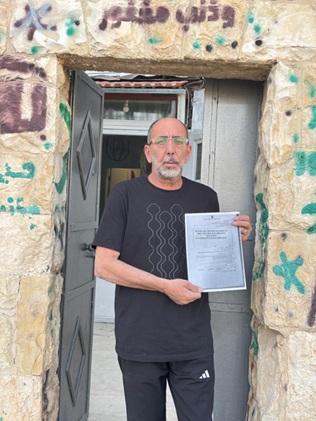
Abed Shaludi at his home in Silwan with the eviction Notice.
A: How did the property reach KKL?
The Jewish National Fund managed to take over about 15 houses and properties of Palestinians in Silwan through a despicable and dubious use of the “Absentees’ Property Law”. Through a conspiracy joined by settlers, KKL, and government entities, the properties were transferred to settlers. The Shaludi family is one of dozens of victims of the method.
First Stage: A dubious declaration of the property as absentee
During the war in 1948, hundreds of thousands of Palestinians lost their homes and lands and became refugees. The young State of Israel decided not to allow them to return to their properties inside Israel and enacted the Absentees’ Property Law, which stipulated that properties whose owners are in an enemy country are vested in the Custodian of Absentees’ Property, and he can sell them to the Development Authority for the purposes of developing the country.
After the occupation of the West Bank in 1967, the government applied Israeli law to East Jerusalem, and over the years began to operate the Absentees’ Property Law there too in order to take over Palestinian properties, even though the law was enacted for entirely different purposes. In the late 1980s, settlers initiated a move to declare properties in Silwan as absentees’ properties, with the involvement of the Jewish National Fund (KKL). They hired Palestinians who declared for them that the owners of certain houses in Silwan are absentees (meaning they reside in an enemy country), and based on these affidavits, and without checking anything, the Custodian declared the properties as absentees’ and sold them to the Development Authority.
Second Stage: An exchange deal with Heimanuta (a subsidiary of KKL)
Immediately after the declaration of the properties in Silwan as absentees’ properties and their transfer to the Development Authority, they were all transferred to KKL in an exchange deal. The Development Authority is committed to an equal distribution of its properties regardless of nationality. KKL’s Heimanuta company, on the other hand, operates according to the KKL memorandum which stipulates that the lands under its ownership shall be transferred solely to Jews. Therefore, in order to transfer properties in Silwan specifically to settlers, an exchange deal was signed on 23.5.91 between the Development Authority and the Heimanuta company, according to which the Development Authority gives the absentees’ properties in Silwan to Heimanuta in exchange for lands under its ownership in the Wadi Ara area.
Third Stage: Heimanuta’s eviction lawsuits against the Palestinian residents
From the moment KKL received the “absentees'” properties in Silwan, it began suing to remove the Palestinian residents from the properties. Concurrently, protected tenancy lease contracts were signed with the Elad Association for those same properties, at a time when the Palestinian residents did not even know that their home had been declared as absentee.
Attorney Avraham Halleli, director of the Land Department at KKL, testified before the District Court within the framework of one of the eviction lawsuits (Civil File 746/93). When asked what policy consideration motivated KKL to receive the lands in Silwan, he answered: “We have an interest that these properties be under Jewish ownership.”
A secret deal with the Elad Association:
Heimanuta managed all the eviction lawsuits on behalf of KKL. In cases where it succeeded in bringing about the removal of the Palestinians from the house – it was always the Elad settlers’ association that received the property. Later it turned out that close to the signing of the exchange deal, KKL signed a secret agreement with the Elad Association according to which the association would take care of the legal representation in the eviction lawsuit, and in return would receive the houses.
In the case of the Shaludi family’s house as well, KKL is operating for the Elad Association. The attorney representing Heimanuta is Avi Segal, the attorney of the Elad Association in many other cases.
For further details on the use of the Absentees’ Property Law to dispossess Palestinians in East Jerusalem, see the Peace Now report “Annex and Dispossess“.
The Commission of Inquiry into the transfer of properties in Silwan (The Klugman Report)
On 16/8/92, the Minister of Justice and the Minister of Finance of the Rabin government appointed an investigation team regarding the transfer of properties in East Jerusalem to settlers (the Klugman Committee). The committee determined, among other things, that “the functioning of the Custodian of Absentees’ Property was by any standard highly flawed… The severe findings regarding the functioning of the Custodian of Absentees’ Property require, in the committee’s opinion, a comprehensive examination and immediate treatment”.
Following the committee’s report, the mechanism established for the purpose of transferring properties in East Jerusalem to settlers was halted, but the moves that already started beforehand, were not canceled, and the legal proceedings that had already been opened – continued. Some of the proceedings continue to this day, as in the case of the Shaludi family.
B. The lawsuit against the Shaludi family
In 1987, the Custodian of Absentees’ Property declared Haj Musa Sumarin, the owner of the Shaludi family’s house, as an absentee. He did so relying on an affidavit that reached him from KKL and the settlers. Musa Sumarin had two houses in Silwan: his residence and another house that he rented to the Shaludi and the Jaabri families. Both houses were sold to KKL in 1991 in the exchange deal behind the backs of the families residing in the houses.
The first eviction lawsuit against the Shaludi family
Immediately after the exchange deal, in 1991, KKL (via the Heimanuta company) filed a lawsuit to evict the Shaludi family from its home in Silwan. In the lawsuit, it turned out that Haj Musa Sumarin was never an absentee. He lived in Jerusalem until his death in 1983 (The Custodian accepted the affidavit he got from KKL without even checking the population registry). Judge Procaccia rejected the lawsuit and ruled that the property is not considered an absentee property, and that the Shaludi family is considered a protected tenant in the house.
Due to the severity of the findings regarding the action of the Custodian of Absentees’ Property, the judge ordered to transfer the judgment to the Attorney General to examine taking measures.
Heimanuta appealed the judgment and managed to convince the District Court that the property is indeed considered an absentee property. True, Haj Musa Sumarin was not an absentee, but his three children are absentees and therefore the transfer of the property to the Custodian and from him to KKL is valid. At the same time, the District Court rejected the other part of the appeal and ruled that KKL has no right to evict the Shaludi family from the house because it is in the status of protected tenancy.
The second eviction lawsuit
In 1997, Heimanuta filed a new eviction lawsuit. This time it claimed that the family was no longer in the status of protected tenancy. KKL sent a private investigator, who posed as a journalist, to Abed Shaludi’s father, and heard from him that he resides in another house. The son, Abed Shaludi, and his family never left the house, but from the moment the court was convinced that the father left the house, it ruled that the family no longer has protected tenancy and can be evicted.
Since the judgment in 2004 and until today, Heimanuta did nothing to implement the eviction. Now, after more than 20 years, it seeks to evict the family based on the 2004 judgment. It should be noted that the judgment ruled that the eviction must wait until a ruling is made in another lawsuit that was taking place in the District Court regarding ownership of the property. The Shaludi family has no information about what happened in the other lawsuit.
The malicious use by KKL of the Absentees’ Property Law
The Absentees’ Property Law was enacted, as stated, in the special circumstances created in the 1948 war. These circumstances did not exist in East Jerusalem in 1967. In fact, in 1968 a government policy was established according to which the Custodian of Absentees’ Property would refrain from operating the law in East Jerusalem, except in cases of open and uninhabited areas. But the Likud government changed the policy after 1977.
Judge Procaccia, who heard the first eviction lawsuit, leveled harsh criticism at the activities of the Custodian and sent the judgment to the Attorney General so that opening proceedings against those involved would be examined.
Thus she determines, among other things, in the judgment:
“The representative of KKL, who is the party interested in purchasing the land, turns to the Custodian and hands him ‘information’ that the property is absentee because its owner is in Jordan, when this information is fundamentally wrong and does not match the factual reality on the ground since the owner was all the time a resident of Jerusalem and was not in Jordan… The Custodian, who knows or is held as one who knows that KKL has a clear interest in purchasing the land, relies blindly and without additional examination on his part on the information (received from KKL)”.
“The process of declaring a property as an absentee property and vesting it in the Custodian of Absentees’ Property is by its very nature a process that significantly harms the human right to protection of private property. For various reasons – among them political reasons – the legislator saw fit to determine as early as 1950 that a property of a person defined as an absentee shall be vested in the Custodian representing for this matter the public interest. Since this is an exceptional process that deviates from the principle of the sanctity of private property and is inherently an expropriation process of private property for the public authority… the process of classifying a person as an ‘absentee’ must be done after careful examination of the factual data on the ground. Relying without independent examination on a turn from a party that has a clear interest in declaring the property as absentee constitutes a deviation from proper procedure, and things take on double severity in view of the legal outcome resulting from the declaration”.
Peace Now: “To our shame, the Jewish National Fund subordinates its assets to the settlement interests of the Elad Association. It is willing to trample the rights of Jerusalem residents, just because they are Palestinians, in order to ‘realize’ assets that should not have reached it in the first place.
KKL can still stop this eviction. It is the plaintiff in the case, it can decide to stop the proceedings and drop the case, it can decide to open negotiations with the Shaludi family and regulate their continued residency under lease conditions. This is in KKL’s hands.”