

Although the Knesset has already begun its pre-election recess, the Knesset Finance Committee is expected to convene next Wednesday, July 29, 2026, to discuss government requests for budget amendments ahead of the elections. Among other requests, the government is seeking to allocate an additional NIS 335.4 million to the Ministry of Settlements, NIS 77.5 million for archaeology in the West Bank, and NIS 658.1 million for security and protection measures, most of which are designated for settlements.
Of the NIS 335.4 million requested for the Ministry of Settlements, NIS 154.313 million is intended for the Settlement Division. The legal opinion attached to the budget request states that the activities of the Settlement Division include NIS 50 million designated for direct funding of the violent farms and outposts in the West Bank. This amount appears only in the legal opinion and not in the budget request itself. It is therefore unclear whether it is included in the budget currently submitted for approval or merely mentioned as one of the Settlement Division’s activities. This may indicate an attempt to conceal the true purpose of the allocation.
Since the current government took office in December 2022, 231 new outposts and farms have been established across the West Bank. They have violently taken control of nearly 20% of the West Bank (more than one million dunams) and have led to the displacement of more than 120 Palestinian communities and residential clusters. The enormous number of these outposts is the result of direct government investment in farms and outposts, despite the fact that they are not considered legal under Israeli law. The legal justification used to enable this funding is that it is allocated for “security components,” which are not considered permanent construction.
These “security components” include, among other things, utility vehicles (Rangers), road construction, solar panels, drones, cameras, electric gates, and more. It should be noted that the first approval of funding for outposts was granted by Naftali Bennett in August 2022, when he served as the minister responsible for the Settlement Division. He approved the Settlement Division’s work plan, which included “planning of essential infrastructure and security components for young settlements.”
Implementation, however, was carried out by the current government through the regional councils of the settlements. This is how Binyamin Regional Council head Israel Ganz described it during the council meeting of May 10, 2023, at which the funding for the farms was approved:
“There is a very interesting and important special budget here, arriving for the first time in history—a special budget for security components in the young settlements. This is part of the government’s and the cabinet’s decision to enable security components in the young settlements. The Central Command determined exactly what goes where, the Settlement Division transfers the money, and we are responsible for implementation. This is the first time that the young settlements are receiving a government budget on the table, that the government is allocating money there for security components.”
These funds financed, among other things, utility vehicles (Rangers), drones, cameras, generators, electric gates, lighting poles, fences, and solar panels for outposts and farms.
In 2023, NIS 28 million was allocated to farms and outposts. During 2024 and 2025, the government transferred an additional NIS 75 million.
To date, the government has funded hundreds of outposts and farms through this mechanism, with a total investment of NIS 103 million. It is now requesting an additional NIS 50 million.
It is important to note that there is a separate budget line, under the responsibility of the Ministry of Defense, for security components in communities throughout Israel and in the settlements. That budget, which exceeds NIS 1 billion annually, is allocated according to established criteria among communities across the country. By contrast, the funding for “security components” for farms and outposts is intended exclusively for farms and outposts in the West Bank and is administered by the Settlement Division.
Peace Now: “In a pre-election budget grab, the government is looting public funds to deepen Israeli control and occupation in the territories. It is now clear to everyone that the violence, attacks against Palestinians, and the dispossession and forced displacement of Palestinians are part of an organized and well-funded government policy. It is no longer possible to claim that this is merely the work of a small group of lawbreakers. It is a small group acting in the service of a government plan.”
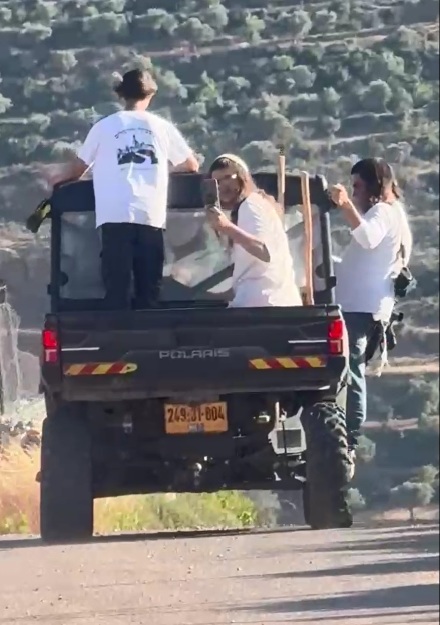
Settlers on a Ranger vehicle of the kind provided by the government near the Palestinian village of Sinjil, summer 2026
Breakdown of the allocations to the Ministry of Settlements
According to the budget request, the government seeks to increase the Ministry of Settlements’ budget by a total of NIS 335.4 million allocated as follows:
- NIS 114.85 million – Existing contractual commitments with the Settlement Division.
- NIS 86.972 million – For communities in northern Israel.
- NIS 10 million – Construction of a temporary neighborhood in the community of Shibolet (a new religious community planned in the Lower Galilee).
- NIS 4.5 million – For Be’er Sheva, Ashkelon, and communities in the eastern Negev.
- NIS 1.65 million – Integration of Ethiopian Israelis into Israeli society.
- NIS 117.318 million – Coalition funds for the Settlement Division’s activities, patrol units protecting land in settlements, and projects relating to Jewish culture and identity.
Additional NIS 77.481 million for archaeology in the occupied territories
The government is requesting an additional NIS 77.481 million for the Civil Administration for “archaeology in Judea and Samaria” and for “supervision and prevention of damage to antiquities, rescue operations, and site development in Judea and Samaria.”
Until the current government took office, the annual budget for archaeology in the West Bank stood at only around NIS 1 million. In 2023, it rose to approximately NIS 22 million, and by 2025 it had reached NIS 64.6 million. The government is now requesting another substantial increase of NIS 77.481 million.
Archaeology serves the settlement enterprise in two principal ways:
- Establishing tourism settlements and creating new sites with permanent Israeli presence and control.
- Removing Palestinian presence under the pretext of protecting antiquities—for example, through the takeover of springs and water sources, home demolitions, and the denial of planning approvals on archaeological grounds.
In recent years, there has been a significant increase in the number of archaeological and tourism sites promoted by the government. Over the past year, thousands of dunams of Palestinian land have been expropriated for archaeological development in Sebastia, Herodium, and Nabi Samuel.
It should also be noted that in February this year, the Israeli cabinet decided to assume supervisory powers over archaeology and environmental matters in Areas A and B, which are under Palestinian Authority control. It is possible that this substantial archaeological budget is also intended to fund enforcement activities inside Palestinian Authority areas.
NIS 658.1 million for emergency expenditures and security measures, most of it for settlements
The government is requesting an additional NIS 658.1 million for civilian emergency expenditures, including civilian protection and security components supplied by the Ministry of Defense to communities throughout Israel. This budget line exceeds NIS 1 billion annually and is distributed among communities according to risk criteria.
Out of this overall amount, the government seeks to allocate NIS 294.5 million specifically to settlements, as part of implementing its January 2026 decision to strengthen “security components” in settlements. The decision allocated NIS 550 million over 2026–2027 for:
- Protection of buses and transportation serving settlers (NIS 100 million).
- Construction of security roads (NIS 125 million).
- Security components in settlements (NIS 325 million).
The current request does not specify how much will be allocated to each purpose, only that the total will amount to NIS 294.5 million.
It is worth noting that the construction of so-called security roads has become one of the principal methods by which settlers take control of extensive areas of land. During 2024–2025, more than 220 kilometers of new roads were opened, enabling the establishment of new outposts and the takeover of additional territory.
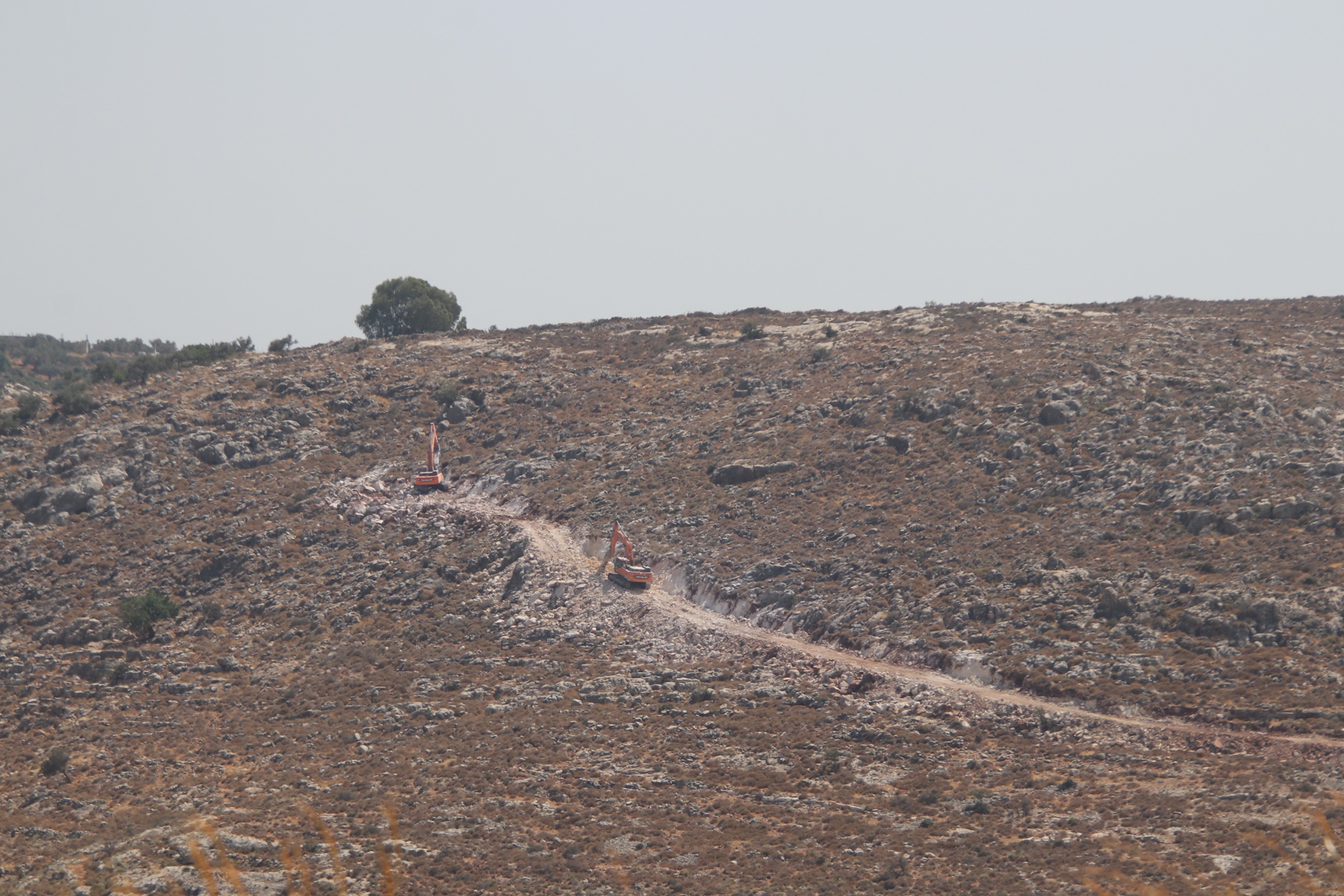
Bulldozers constructing a road for a new settlement west of Ramallah, July 2026.