

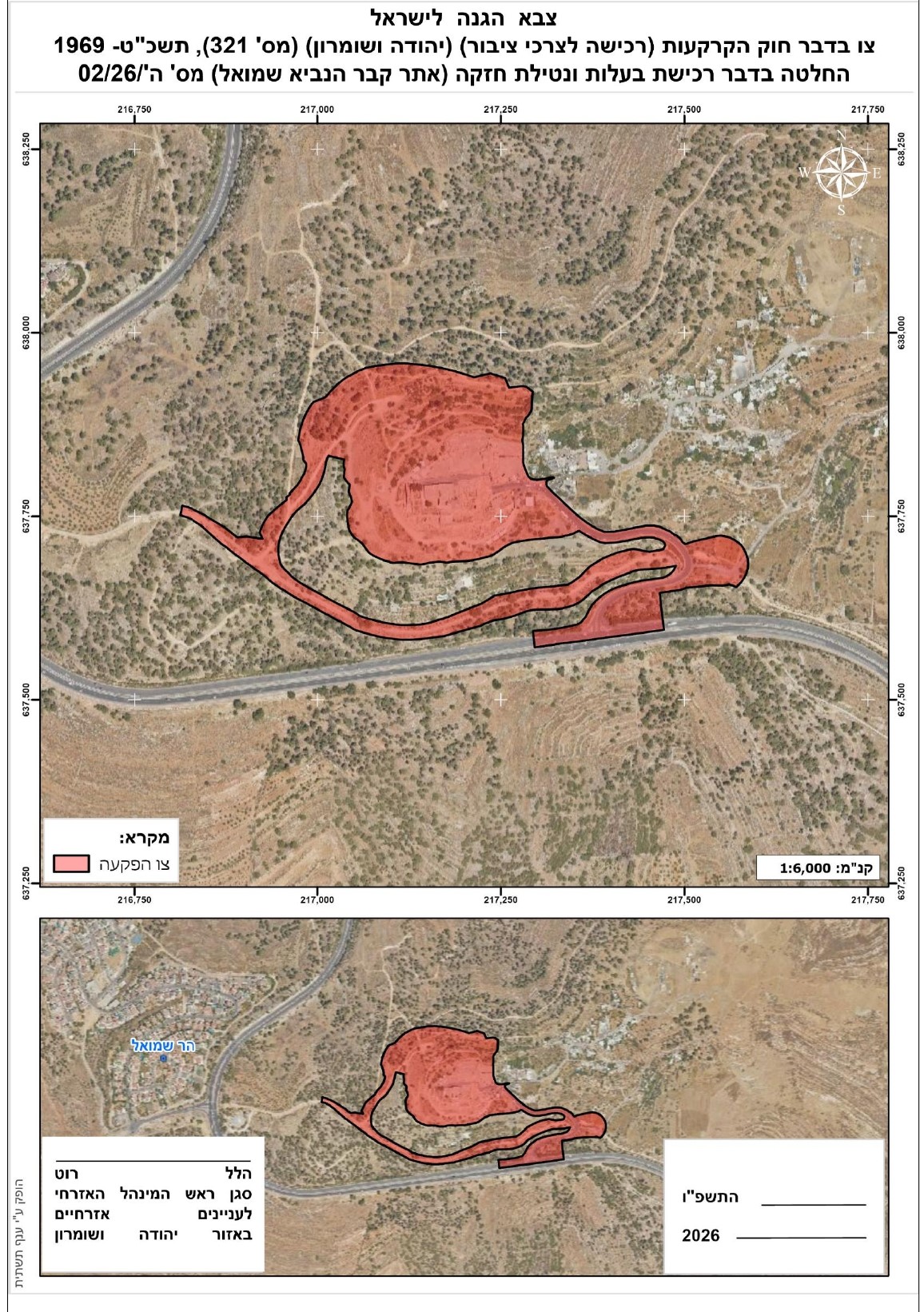
The Israeli Civil Administration has issued an expropriation order (“acquisition for public purposes”) for the Nabi Samuel/al-Nabi Samwil site (Expropriation Order H/02/26), located north of Jerusalem. The site includes a mosque owned by the Muslim Waqf, which serves as the traditional tomb site of the Prophet Samuel. This marks the first time that the Civil Administration has expropriated a holy site owned by the Muslim Waqf in the occupied West Bank.
The expropriated area covers 109.79 dunams and includes the Mosque, the archaeological site surrounding the mosque, the spring at its foothill, agricultural lands, and the access roads to the site.
It should be recalled that in September 2025, the head of the Civil Administration signed an expropriation order for the open area at the center of the Patriarch Tomb/Ibrahimi Mosque in Hebron. At the time, this was considered the first expropriation involving a holy site, although the Civil Administration argued that the order concerned an open area intended for roofing works within the cave complex itself, rather than a built religious structure. The dangerous precedent set in Hebron did not stop there. This time, the Civil Administration is expropriating nearly 110 dunams of land, including the mosque and the traditional tomb site of the Prophet Samuel.
The Nabi Samuel/al-Nabi Samwil Site
Nabi Samuel/al-Nabi Samwil is located north of Jerusalem, approximately one kilometer from the Israeli neighborhood of Ramot. A Palestinian village once stood at the site, but it was demolished by the Israeli military in 1971, forcing its residents to relocate several hundred meters to the east.
In 1995, the area was declared a national park and archaeological excavations were carried out there. Jewish, Muslim, and Christian traditions all identify the site as the burial place of the Prophet Samuel. Since the 1980s, the site has functioned as a place of worship for both Muslims and Jews, each praying in separate sections of the compound, which remains under Muslim Waqf ownership.
In 2013, the Staff Officer for Parks and Nature Reserves (the equivalent of the Israel Nature and Parks Authority in the West Bank) submitted a development plan for the site. However, the plan was rejected in 2018 following objections submitted by local residents and other stakeholders.
Peace Now: “Once again, we find ourselves confronting decisions by the Civil Administration, operating under Minister Smotrich, that are intended to expand and deepen annexation. From plans to expand settlements and unprecedented declarations of ‘state land,’ the Civil Administration has moved on to taking control of heritage sites and is now appropriating religious sites, creating tension in some of the most peaceful and sensitive places in the West Bank. The messianic agenda of the Israeli government should have been stopped long ago. Instead, each passing day appears to further endanger us and create the conditions for transforming a political conflict into a religious war.”
Implications and Risks of the Move
Unnecessary Religious Escalation: For decades, Jews and Muslims have prayed in separate sections of the mosque compound without significant incidents or harm to the religious sensitivities of either side. The expropriation of the compound is a troubling indication of a broader trend toward the seizure of religious and holy sites, a development likely to intensify religious tensions both at Nabi Samuel and throughout the West Bank.
Violation of International Agreements and International Law: Until now, Israel had refrained from expropriating religious sites, recognizing that such sites in occupied territory constitute part of the cultural and heritage assets of the Palestinian population. The decision to expropriate religious sites, alongside parallel expropriation processes targeting heritage sites such as Sebastia and others, represents a continuation of policies dispossessing Palestinians of their cultural and religious heritage, in violation of international law.
Risk of Escalation into Religious Conflict: Harm to a site considered holy by Jews, Muslims, and Christians risks strengthening the religious dimension of the conflict, fueling tensions, and empowering extremist actors. The management of the site should instead be conducted with sensitivity, restraint, and coordination with both the Muslim Waqf and the Palestinian Authority.
The Next Target: Al-Aqsa Mosque/Temple Mount? In recent years, the Israeli government and police have enabled extremist Temple Mount activists, alongside their political representatives within the government, to alter the longstanding status quo at Haram al-Sharif/Temple Mount and carry out ongoing provocations. According to intelligence documents reportedly disclosed publicly, these developments were among the factors contributing to Hamas’s 7 October 2023 attack. One of the recurring fears expressed on the Palestinian side is that Israel may expand expropriation measures to additional religious sites, including Haram al-Sharif/Temple Mount itself.
The Solution: There is no need to intervene in and deepen a conflict where none currently exists. More importantly, only a negotiated agreement with the Palestinians can ensure a framework for religious worship that respects and accommodates the needs and rights of all faith communities.