

by Hagit Ofran
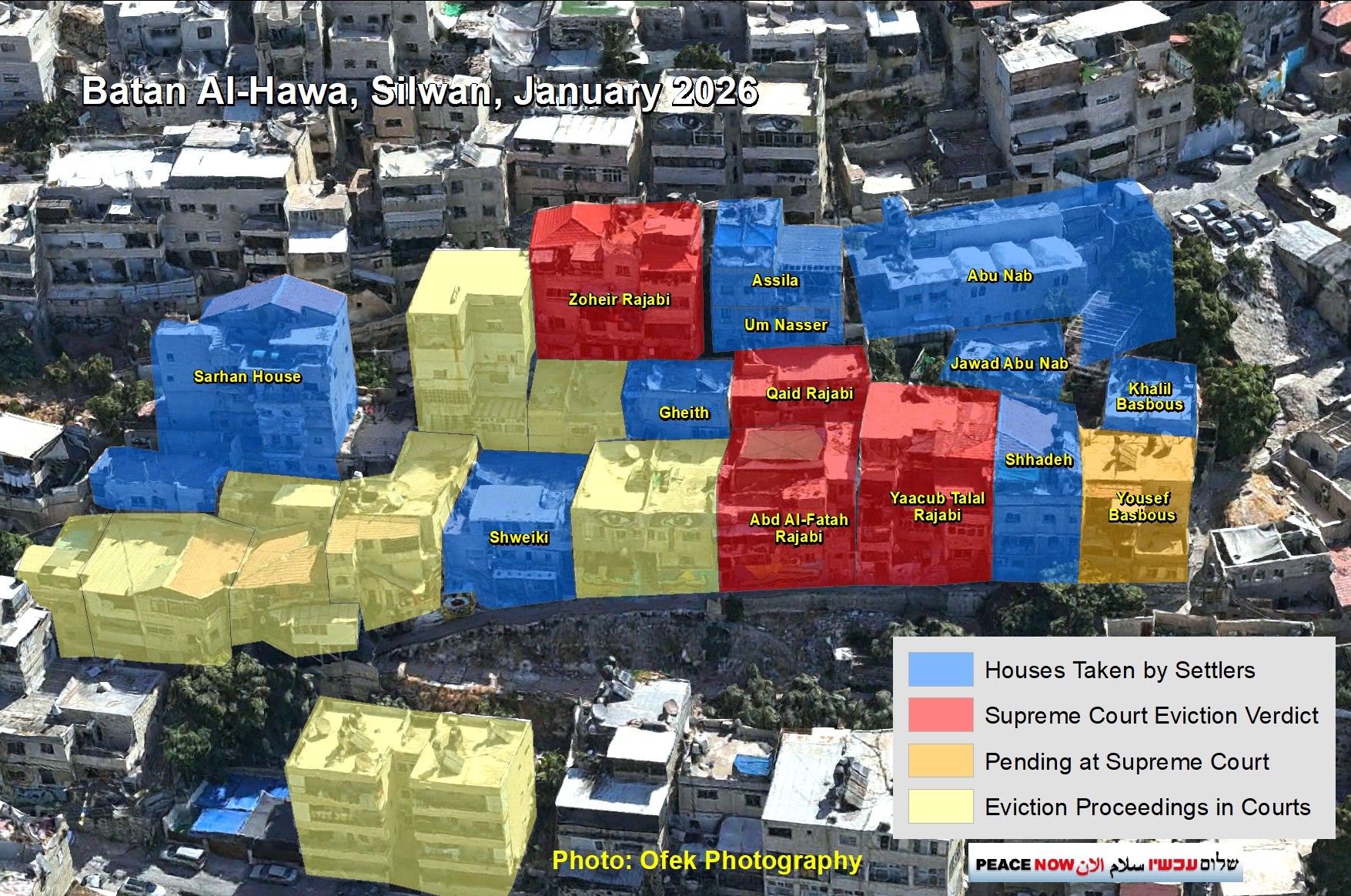
Over the past two years, 64 Palestinians from 11 families have lost their homes in the Batan al-Hawa neighborhood of East Jerusalem, which were transferred to settlers. Relying on a special law that could be described as “the Jewish right of return law,” Israel’s Supreme Court rejected the appeals of dozens of additional families from Batan al-Hawa over the past year. In a steadily increasing drip, judges in Jerusalem’s Magistrate, District and Supreme Courts have issued rulings that seal the fate of dozens of Palestinian families who now face eviction in Silwan, Sheikh Jarrah and the Old City.
In all of these cases, the lawsuits are based on the principle of the right of return and on the law that enables it. In each instance, the claim is that the land was owned by Jews prior to 1948 and that settlers, acting in their name, are now entitled to reclaim it. But this right applies only to Jews. It does not apply to Palestinians.
Two Populations, the Same Circumstances — Different Law
In 1948, a bloody war broke out in Mandatory Palestine between Jews and Arabs, during which hundreds of thousands of people were uprooted from their homes. During the war itself, the Israeli government decided not to allow Palestinian refugees to return to their homes.
In 1950, the Knesset enacted the Absentees’ Property Law, which stipulated that the property of Palestinian refugees would not be returned to its owners, and that the government could use and sell it for the purpose of developing the country.
In the Jerusalem area, approximately 35,000 Palestinians lost their homes during the war (in neighborhoods such as Talbiya, Katamon, Baka’a, Deir Yassin and others, according to data from the Zochrot organization) while about 2,000 Jews lost their homes, mainly in the Old City and Sheikh Jarrah.
All of the Palestinians became refugees, received no compensation and were settled in refugee camps. By contrast, all of the Jews received immediate compensation from state institutions in the form of alternative housing and were resettled within the territory of the State of Israel.
In 1967, following the Six-Day War, the Israeli government decided to annex approximately 70 square kilometers in the Jerusalem area, including about 70,000 Palestinians who became permanent residents of Israel. The annexation of East Jerusalem raised a number of legal questions requiring regulation, including the issue of Jewish-owned property that had existed prior to 1948 and had been under Jordanian control for 19 years, until 1967.
To address these issues, the Legal and Administrative Matters Law was enacted in 1970. The law dealt with matters such as the licensing of accountants in East Jerusalem, the legal status of corporations registered in Jordan, and similar issues, as well as the question of Jewish-owned property in East Jerusalem. It determined that such properties would be returned to their owners.
The result is that in one city, as a consequence of one war, there are two populations that lost property — but only one national group is entitled to reclaim its property (even though it has already received compensation for it), while the other population, sometimes living only a few hundred meters away from its former property in West Jerusalem (to which the law does not apply), is barred from reclaiming it. This is the original sin for Israel’s policy in East Jerusalem.
But the injustice created by the law lies not only in the unequal legal regime it applies to different populations; it is also rooted in the way the law has been implemented and interpreted by Israeli courts — and in the wide gap between those interpretations and the original intent of the legislators.
A review of the legislative protocols indicates that lawmakers envisioned a situation in which Jews would be able to reclaim vacant properties, while in cases where properties were occupied, they would receive financial compensation. The legislators took into account the personal attachment of an individual to their property. In practice, however, the law and the mechanism established to implement it — through the General Custodian — have been exploited by settlers who have no connection whatsoever to the original owners.
The Palestinian residents of Batan al-Hawa lawfully purchased their land during the Jordanian period, and some even after 1967, and built their homes there. For decades, no one challenged their ownership. Even the General Custodian, whose role is to manage Jewish-owned properties in East Jerusalem, remained silent.
However, at the end of the 19th century, a religious endowment known as the Benvenisti Trust was established in Jerusalem. The trust built two elongated residential buildings with dozens of housing units on that same plot of land for impoverished Yemenite Jews in Jerusalem. In the 1930s, amid rising tensions between Jews and Arabs, the British authorities ordered Jewish residents of Silwan to leave the neighborhood, and the trust was abandoned.
Seventy years later, representatives of Ateret Cohanim came before the court and “volunteered” to manage the abandoned trust. The court appointed them as trustees, and in the name of that trust they approached the General Custodian, requesting that the property be released to them — even though it was already inhabited by hundreds of Palestinians.
The General Custodian did not ask questions or conduct examinations, did not notify the residents, and granted the settlers their request. Armed with documents from the General Custodian, members of Ateret Cohanim began filing eviction lawsuits against the Palestinian families.
In court, the proceedings are conducted as though this were a real estate dispute between two equal parties asserting rights to a property. In reality, however, this is an entire mechanism of dispossession driven by ideological motives, wholly disconnected from the original purposes of the law.
Facing well-organized and well-funded settler organizations are impoverished Palestinian families, caught in a long, difficult and exhausting legal process. Experts in international law have determined that applying this law to dispossess Palestinians in East Jerusalem violates international law.
Ultimately, the courts do not go out of their way to prevent this injustice, which cries out to the heavens. It is easy for them to hide behind the letter of the law and to view the narrow picture divorced from its true context. Perhaps that is the heart of the problem: when the foundation is crooked, the entire structure is crooked, and when the law itself is discriminatory, only judges who go beyond the narrow reading of the law can prevent injustice.
But the legal arena is not the only arena. This is a process with far-reaching implications for the prospects of peace, for stability in Jerusalem, and for the lives of thousands of residents. The government is authorized — and obligated — to intervene, and it has the power to prevent the evictions (see here how).