May 31, 2026 | Updated June 4, 2026
The Knesset passed the settlement tax benefits bill into law on the night of June 3–4, 2026, in its second and third readings, by a vote of 32 to 23. The law designates 58 settlements as communities whose residents are entitled to a 7% income tax break of up to 10,000 NIS per person per year, with an estimated public cost of 130 million NIS annually. The law will remain in effect through December 31, 2027, with the Finance Minister authorized to extend it by up to two additional years at a time.
The Finance Committee had convened on Monday (June 1) to finalize the bill ahead of the vote. Under the law, dozens of settlements are designated as communities whose residents are entitled to far-reaching tax discounts — amounting to approximately 1,000-4,000 NIS per month in net income, deposited directly into settlers’ bank accounts. Professional staff at the Ministry of Justice and the Ministry of Finance opposed the bill on economic grounds, citing concerns over inequality and the fact that it grants sweeping benefits to a specific sector on the eve of elections.
Why Settlement Tax Benefits Are Unjustifiable
1. Settlements already receive disproportionate government investment across virtually every sector. The proposed tax benefits are a gift to supporters of Smotrich’s Religious Zionism party and an electoral bribe.
2. The security rationale is a pretext. The ostensibly security-based criterion — requiring armored school buses — was specifically tailored to include only settlements. Against threats such as explosive drones and missiles, of the kind faced by communities in northern Israel, armored buses are simply irrelevant.
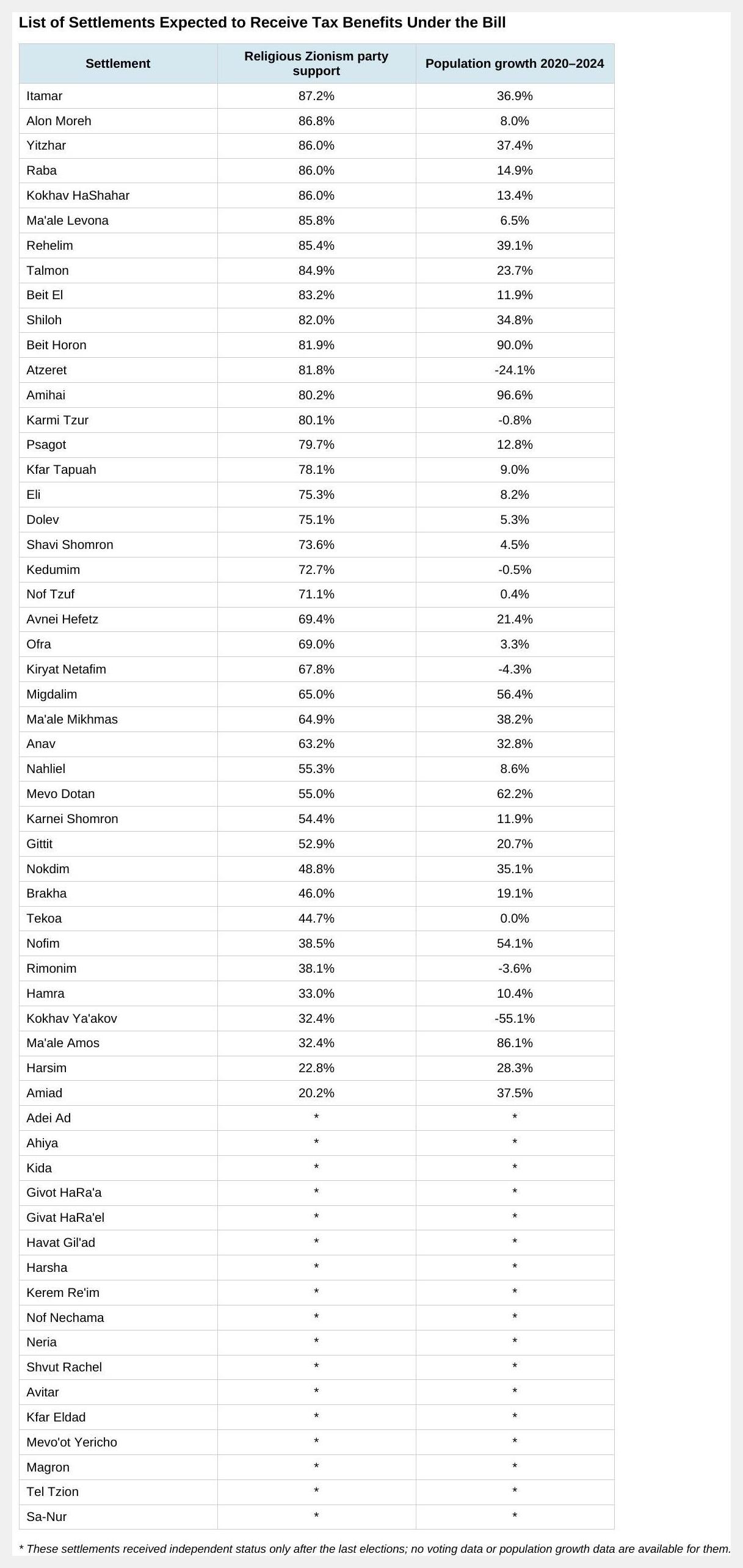
3. These settlements are already growing rapidly. A Peace Now analysis found that the settlements slated to receive tax benefits under the bill grew by an average of 22% over the past five years. Growth at that rate provides no justification whatsoever for tax incentives.
4. Tax benefits are a costly and ineffective instrument. Tax breaks have been shown to be ineffective at encouraging migration to peripheral communities. A recent Bank of Israel study found that while such benefits cost the public 0.7 billion NIS annually, they do not change population levels in the periphery.
5. Settlements are a security and diplomatic burden on Israel. Ultimately, the settlements serve no Israeli interest beyond that of the settlement enterprise itself. They prevent Israel from reaching an end to the conflict and impose a security burden on the IDF. Israel’s actual interest lies in not encouraging Israelis to move to the settlements.
Peace Now: “The proposal to grant tax benefits to settlements is brazen greed on the part of settlement leaders. No sector in the country receives more benefits and public investment than the settlers, and there is no justification whatsoever for adding tax breaks that would simply plunder the public treasury for the benefit of a small minority within the government’s political base.”
A review of the list of settlements expected to receive tax benefits under the law reveals that these are settlements with overwhelming support for Smotrich’s Religious Zionism party. According to voting data from the last Knesset elections (2022), the party’s average support in these settlements was 65%. Population growth in these settlements over the past five years averaged 22%.
How the Bill Evolved
The original version of the bill sought to extend the tax benefit to all settlements, but given its enormous cost — approximately 450 million NIS per year — and in the face of opposition from the parliamentary opposition and professional staff, it was scaled back to cover “only” 58 settlements, at an estimated annual cost of approximately 130 million NIS.
Although this is a private member’s bill (sponsored by MK Sukkot as a frontman for Finance Minister Smotrich), Smotrich attended committee sessions over recent weeks and submitted his own version of the text for deliberation. In an attempt to blunt opposition to the bill, Smotrich proposed adding several northern communities to the bill, but that addition was apparently not put to a vote after it became clear it would not increase support for the bill.
The stated justification for selecting which settlements qualify for the benefit is a security pretext. Under the bill, settlements located more than 2 kilometers from the separation barrier whose children’s transportation requires armored buses, per Ministry of Defense guidelines, would be eligible for the tax break.
The committee’s legal counsel determined that the criteria are not equitable but rather ones “tailored for a specific purpose in a manner that may exclude other communities whose security needs are no lesser than those stipulated in this proposal.”
Current Data on Settlement-Specific Grants
A Peace Now analysis found that settlements receive disproportionate government investment across virtually every sector — in government budget allocations to local authorities, in government investment in education, and in Ministry of Interior grants. [See full breakdown here.]
According to current Ministry of Interior data, in 2025 settlements received regular and settlement-specific grants totaling 845 million NIS, representing approximately 11.2% of all grants the Ministry disbursed to local authorities in Israel — meaning settlements received 2.3 times their proportional share relative to their population.
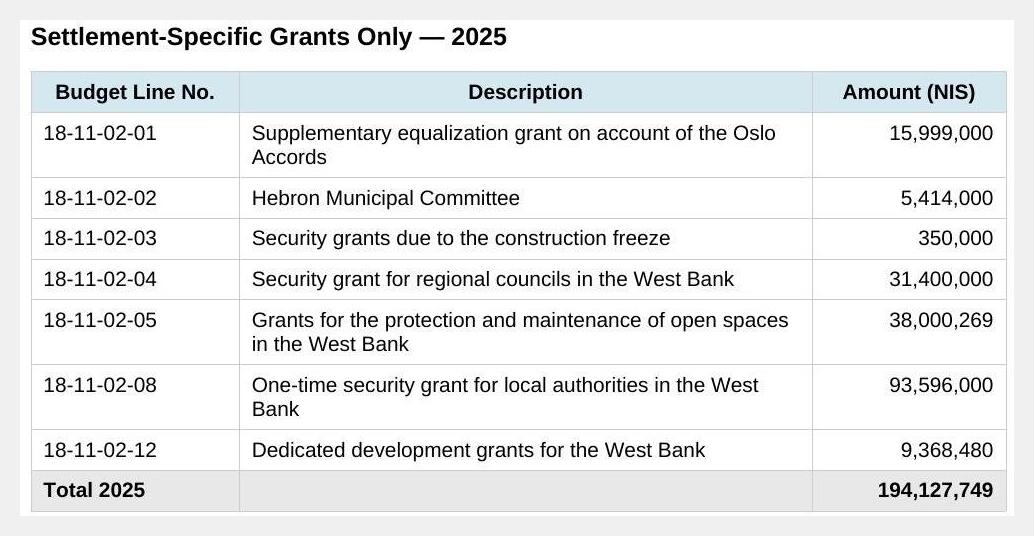
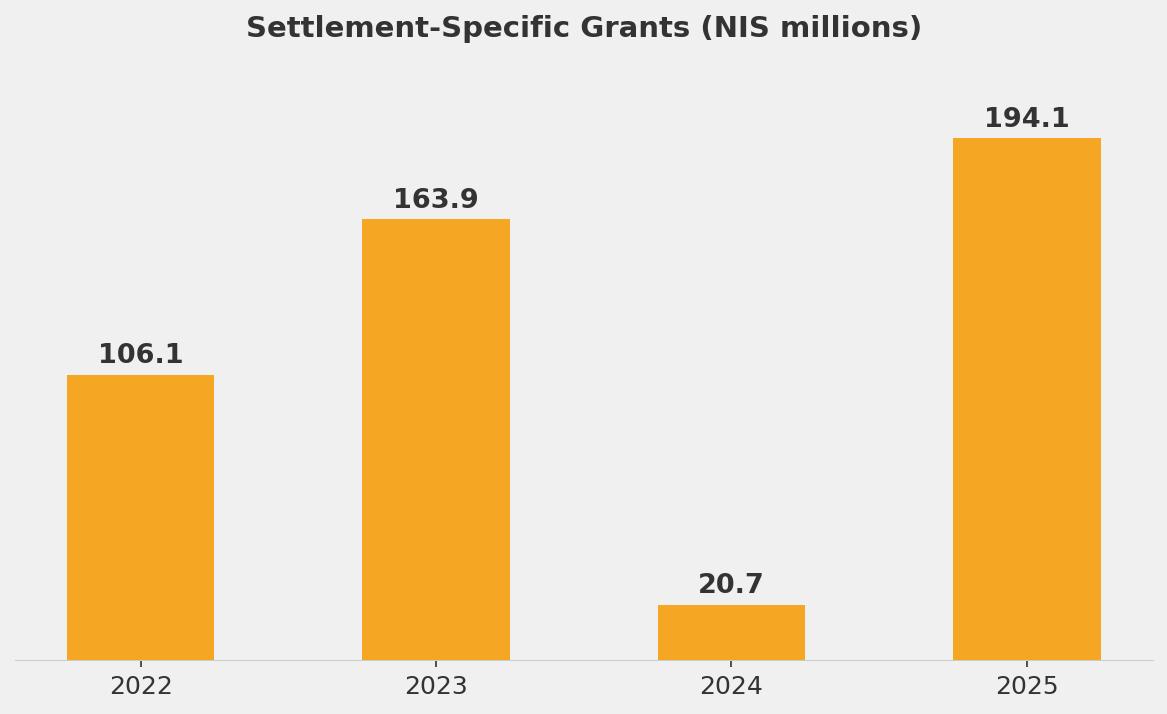
In addition to the regular grants that settlements receive from the Ministry of Interior on the same criteria as other local authorities, settlements receive grants available exclusively to them. In 2025, these settlement-specific grants broke all previous records, reaching 194.1 million NIS. In 2026, through April alone, the Ministry of Interior had already transferred 134.4 million NIS in settlement-specific grants to settlement authorities.