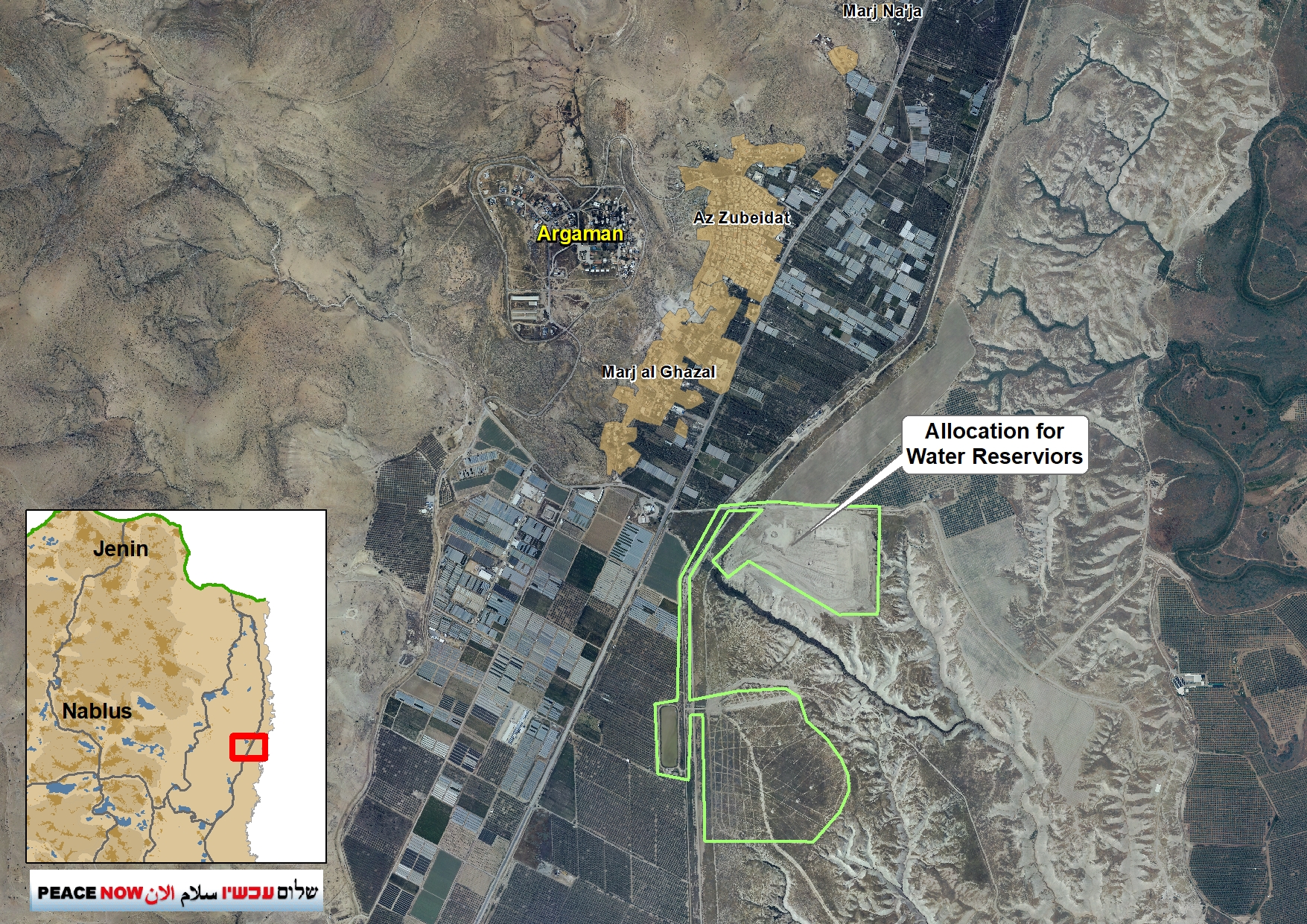
Since the elections, the Custodian of Government Property in the Civil Administration has announced the allocation of at least 28,105 dunams (approx. 6,945 acres) for grazing across the West Bank, alongside an additional 584 dunams (approx. 144 acres) for constructing water reservoirs near the village of Fasayil in the Jordan Valley. This area—larger than the Israeli cities of Herzliya, Karmiel, or Kiryat Gat—is being distributed to just nine settlers.
These vast tracts of land handed over to settlers are part of a broader phenomenon involving the establishment of grazing outposts and the systematic expulsion of the Palestinian presence from wide swaths of the West Bank. According to estimates by the Kerem Navot organization, by the end of 2025, settlers had taken over more than one million dunams (nearly 20% of the West Bank) using this method, denying Palestinians access to the land. While most settler land grabs occur without any official allocation—and even where allocations exist, settlers de facto seize far larger areas than officially granted, including private Palestinian land—these grazing allocations enable settlers to receive official state funding and subsidies.
Peace Now: “The allocation of tens of thousands of dunams to settlers for ‘grazing’ is direct support for the systematic expulsion of Palestinians from their lands and the rampant criminal violence in the West Bank. A government that lost the elections has no mandate to establish facts on the ground in a matter so fateful to the country’s future. The next government will have to cancel all grazing allocations and begin combating settler terrorism.”
Publication of Allocation Notices
The allocations were published in accordance with a new procedure established following a Peace Now petition, which obligates the Civil Administration to publish land allocations in advance. However, the notices of intent to allocate land for grazing do not specify who the intended recipients are, nor whether they constitute a renewal of an existing allocation or a new one.
All grazing allocations are made without a tender, leaving both the selection process for the settlers receiving these vast tracts and the terms of the allocations entirely opaque.
In all the areas now being allocated, settlers have already been operating in recent years, using the land for grazing and to drive Palestinians out of the vicinity. Some of the allocations lie within military firing zones and nature reserves, and in several cases, they include lands previously used by expelled Palestinian communities. It is worth noting that if the state genuinely sought to promote grazing in these areas, it could have allocated the land to residents of the local Palestinian communities who already graze their flocks there—or at least did so until settlers arrived and forced them out.
A defining feature of these allocations is that they consist of non-contiguous plots. This stems from the fact that the state can only allocate land classified as public (“state land”), while the surrounding plots are privately owned Palestinian land. Naturally, settlers also make use of these private plots, if only to traverse between the parcels allocated to them.
In February 2025, the Custodian of Government Property first announced grazing allocations totaling 16,151 dunams. In January 2026, an additional allocation of roughly 533 dunams east of Nablus was published. Now, at least nine new allocations totaling 28,105 dunams have been announced.
In total, the Civil Administration has published grazing allocations covering at least 44,182 dunams (approx. 10,918 acres).
Notably, only four of the nine most recent allocations were published on the Civil Administration’s website, while the rest appeared only as notices in daily newspapers. Consequently, there is a reasonable likelihood that additional allocations have been made without coming to our attention.
Furthermore, allocations by the Custodian of Government Property represent only a small fraction of the grazing lands transferred by the state to settlers. The vast majority of grazing allocations are carried out by the Settlement Division—a non-governmental body entrusted by the state with managing hundreds of thousands of dunams in the West Bank. The Settlement Division manages these lands in the shadows, without oversight or minimal adherence to rules of proper governance. In May 2024, during a still-pending Peace Now petition demanding transparency from the Settlement Division, the State Attorney’s Office informed the High Court that, according to the Division, roughly 80,000 dunams had been allocated for grazing (with additional lands likely allocated since).
Recent Allocations During and After the Election Period
| Publication Date | Allocation No. | Purpose | Area (Dunams) | Village Lands |
|---|---|---|---|---|
| 12/10/2026 | 203033134 | Temporary use for grazing | 1,204.54 | Rammun, Deir Dibwan |
| 01/11/2026 | 203038072 | Temporary use for grazing | 8,335.88 | Zawiya, Rafat, Deir Ballut |
| 01/11/2026 | 203038297 | Temporary use for grazing | 1,151.85 | Arraba, Kafr Ra’i, Ya’bad |
| 06/11/2026 | 203038098 | Temporary use for grazing | 1,289.46 | Taybeh, Rammun |
| 09/11/2026 | 203037588 | Temporary use for grazing | 1,460.14 | Abud, Al-Lubban al-Gharbi |
| 09/11/2026 | 203033143 | Temporary use for grazing | 4,037.60 | Tubas |
| 10/11/2026 | 203033181 | Temporary use for grazing | 5,545.26 | Fasayil, Kafr Malik |
| 11/11/2026 | 203038351 | Engineering facilities | 584.17 | Ghor al-Far’a |
| 13/11/2026 | 203038097 | Temporary use for grazing | 4,316.81 | Tubas, Tayasir |
| 13/11/2026 | 203038715 | Agricultural produce processing | 179.54 | Qalandiya |
| Total | 28,105.25 |
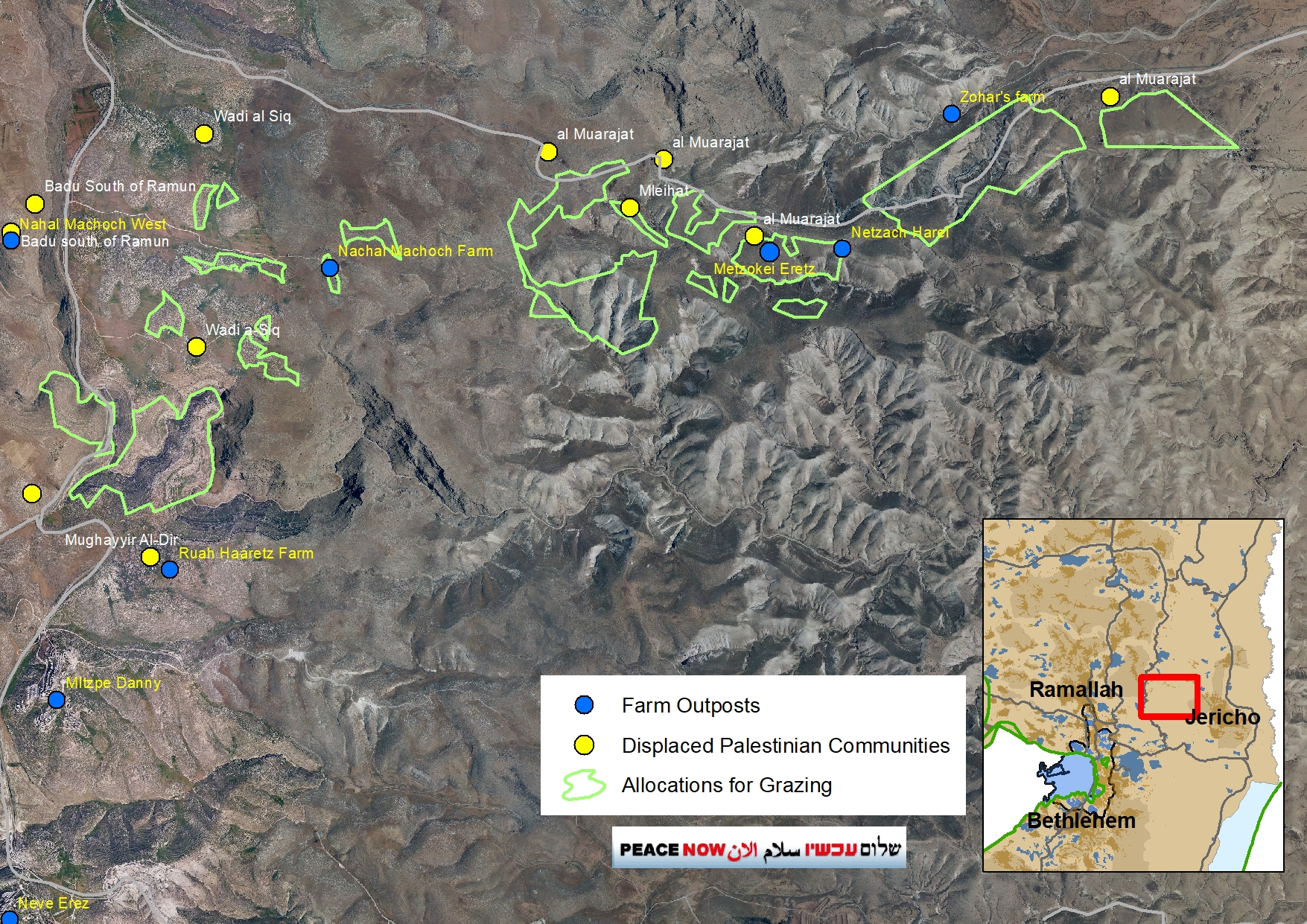
1. Allocations in the Mu’arrajat Area East of Ramallah (Vicinity of Nahal Machoch, Netzach Harel, and Zohar’s Farm Outposts)
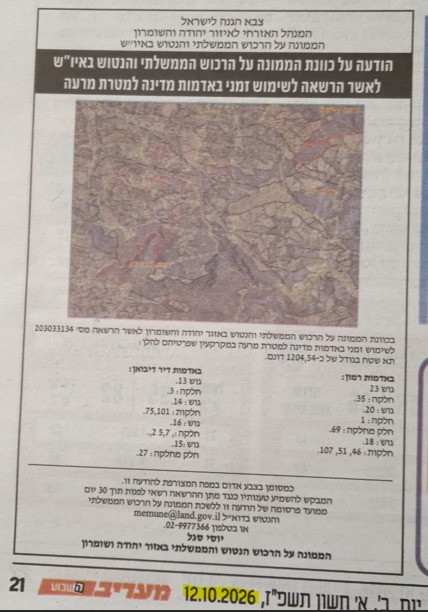
In the Mu’arrajat area east of Ramallah, on lands belonging to the villages of Taybeh, Rammun, and Deir Dibwan, two grazing allocations were published: one on October 12, 2026, for 1,205 dunams, and a second on November 6, 2026, for 1,289 dunams. The allocations are located in an area where settlers Neria Ben Pazi and Zohar Sabah operate, having established several farming outposts there in recent years. Alongside the establishment of these outposts—and as a result of settler harassment and violent attacks—thousands of Palestinians from local herding communities were driven out of the area. Prior to their expulsion, these communities used the allocated lands for grazing.
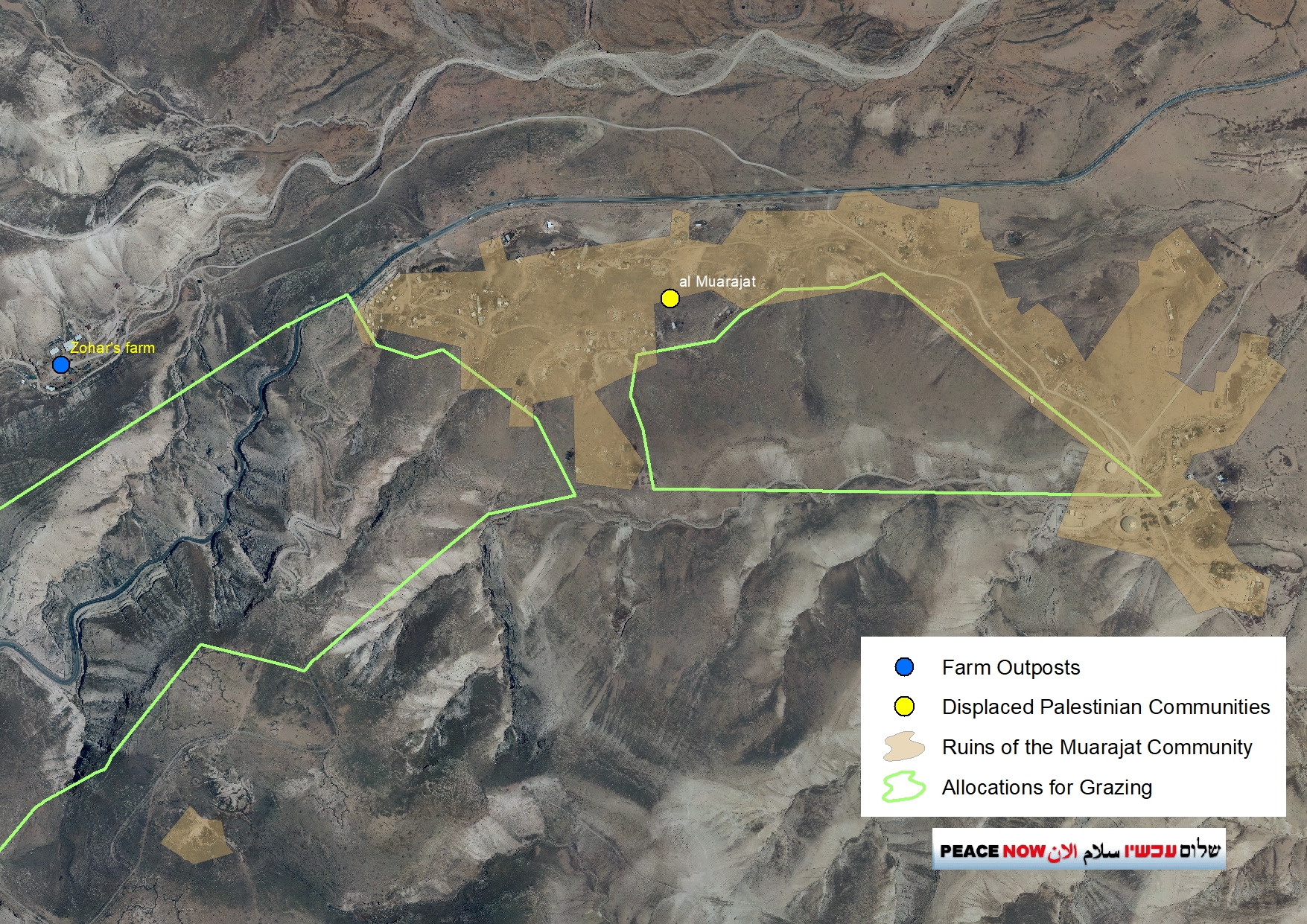
The November 6, 2026 allocation encompasses a large area amid the ruins of the Palestinian community of Mu’arrajat, which was expelled in the summer of 2025. Residents of the community petitioned the High Court of Justice through Attorney Neta Amar-Shiff demanding to be allowed to return to their homes. In response, the state claimed there was no impediment to their return. Under pressure from the court, a date was even set for their return, yet on that very day, they were attacked again by settlers and forced to flee.
The petition remains pending, and the state continues to claim nothing prevents the residents from returning. Now, it turns out the state is allocating the very lands used by Mu’arrajat’s residents—right among the ruins of their homes—for settler grazing. Such an allocation amounts to an admission by the state that it seeks to cement a permanent settler presence in the area, which will definitively prevent the Mu’arrajat community from ever returning home.
2. Allocation for “Agricultural Produce Processing” on Qalandiya Lands (East of Qalandiya (Atarot) Airport, Straddling the Separation Barrier)
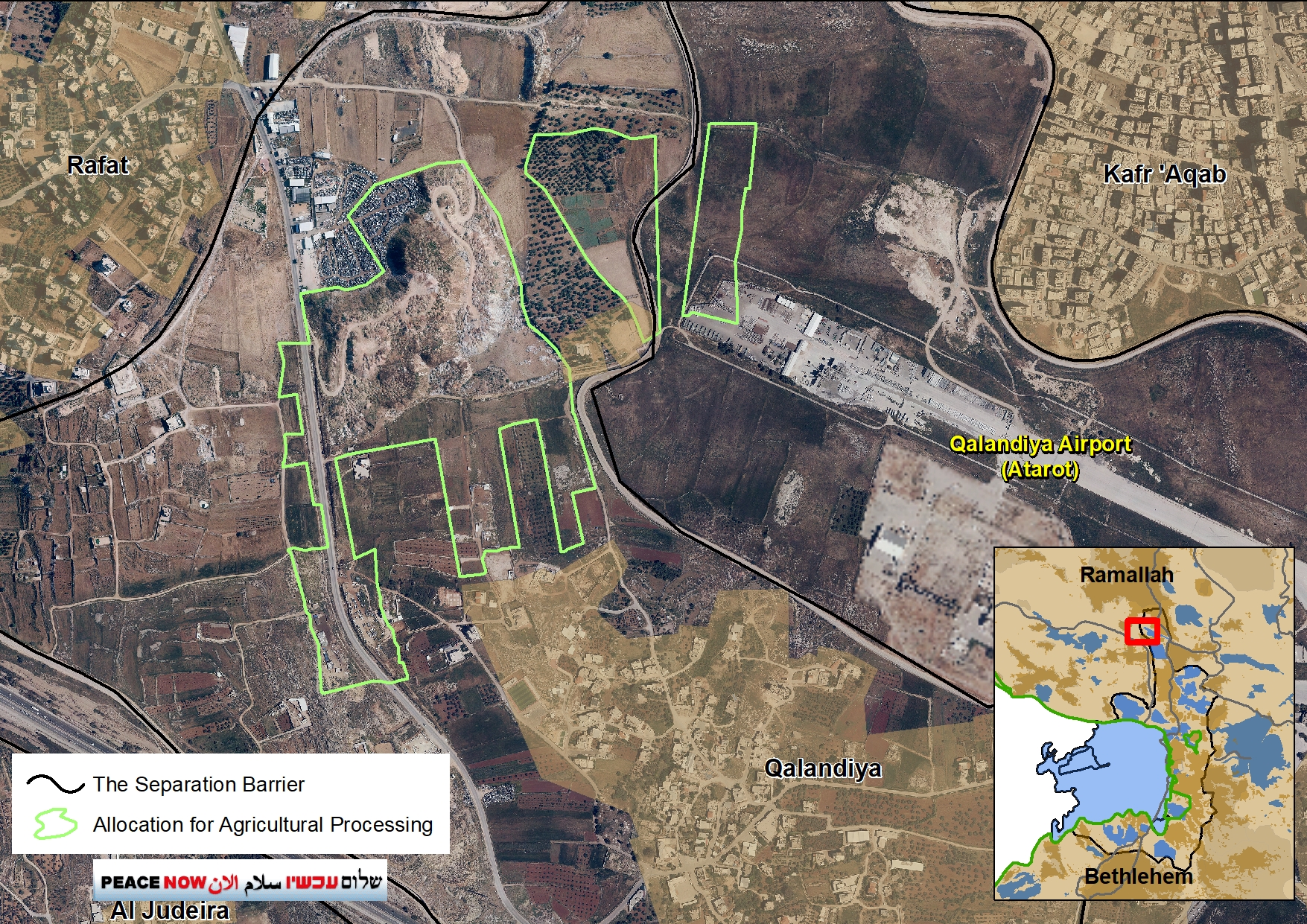
A particularly puzzling allocation is that of 180 dunams for “agricultural produce processing” on the lands of Qalandiya, southwest of Ramallah. Most of this area lies outside the Separation Barrier, with a portion inside it, situated in a densely populated Palestinian area devoid of any Israeli presence between Kafr Aqab, Rafat, and Qalandiya. The purpose of the allocation is also unclear. Typically, agricultural produce processing involves handling harvested crops (packaging, refrigeration, cutting, etc.), which requires a relatively modest area of just a few dunams to build a facility. The current allocation spans 180 non-contiguous dunams, partly on the other side of the Separation Barrier (including a small plot inside the old Qalandiya Airport), and we are unaware of any agricultural crops in the vicinity requiring processing. By comparison, in March 2026, the Custodian allocated just 6.83 dunams for agricultural produce processing on Al-Jib lands between Giv’at Ze’ev and Har Shmuel settlements.
Furthermore, there is a contradiction between the text of the notice of intent—which states the land is for agricultural produce processing—and the title of the attached map, which refers to a grazing allocation. Over the past twenty years, a large portion of this allocated land has served as a construction waste dump, accumulating massive amounts of dirt and debris.
3. Allocation in the Deir Ballut, Rafat, and Az-Zawiya Area South of Qalqilya (Vicinity of Shir David Farm Outpost)
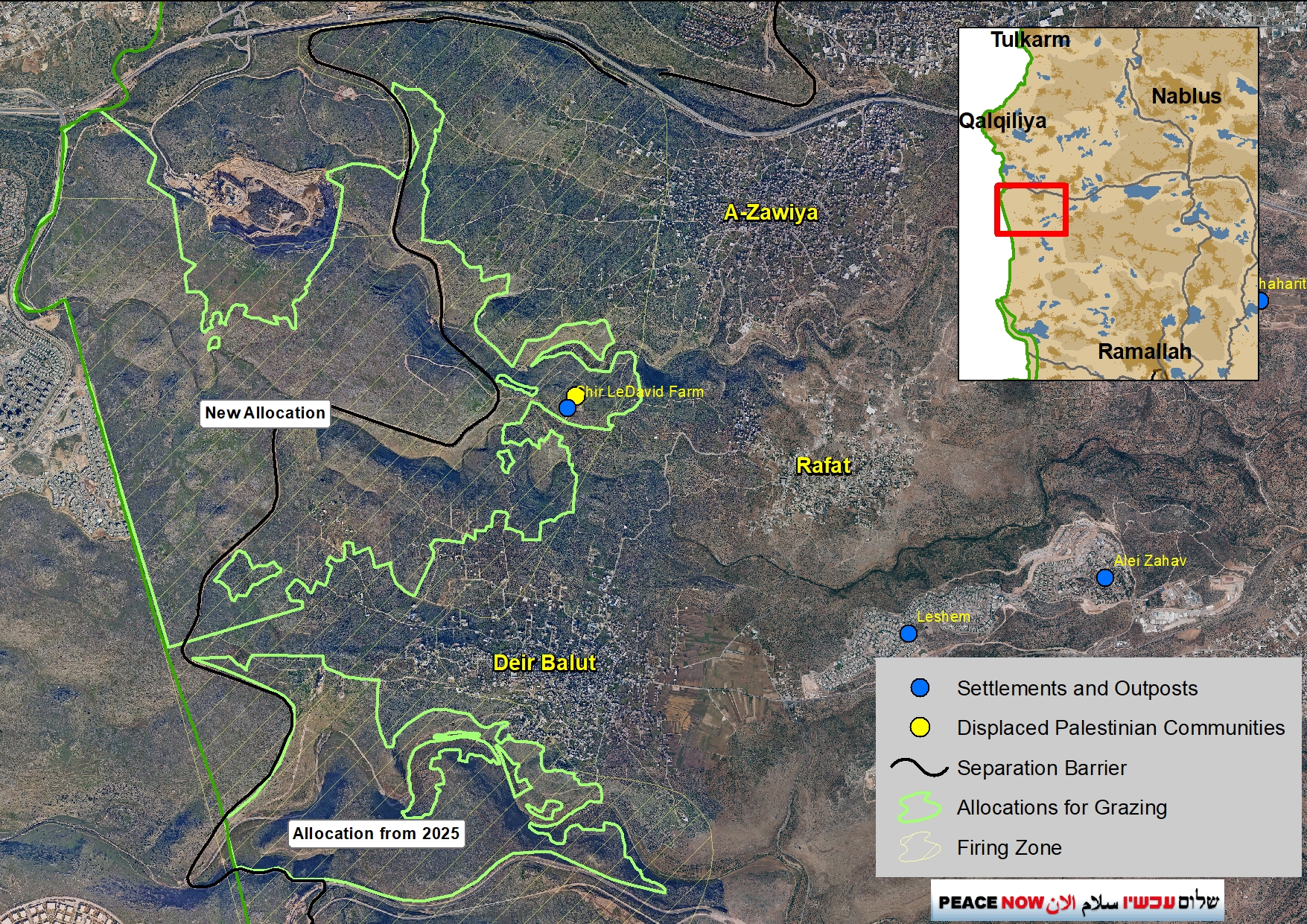
The largest allocation, spanning 8,336 dunams, is located south of the “Nahal Raba” quarry on the lands of the villages of Deir Ballut, Rafat, and Az-Zawiya. Nearly the entire allocated area lies within a declared military firing zone and spans both sides of the Separation Barrier. In recent years, the government has been advancing plans for an industrial zone and a cemetery for Israelis immediately north of the allocation.
In the eastern section of the allocation, the “Shir LeDavid” outpost was established about a year ago by Elhanan and Hadas Lerner, adjacent to a Bedouin community that was expelled due to settler violence. In December 2025, the government decided to establish a new settlement named “Rosh HaAyin East” in the eastern part of the land now allocated for grazing.
4. Allocation on Lands Near Ya’bad and the Mevo Dotan Settlement Southwest of Jenin (Vicinity of Ma’oz Zvi and Emek Dotan Farm Outposts)
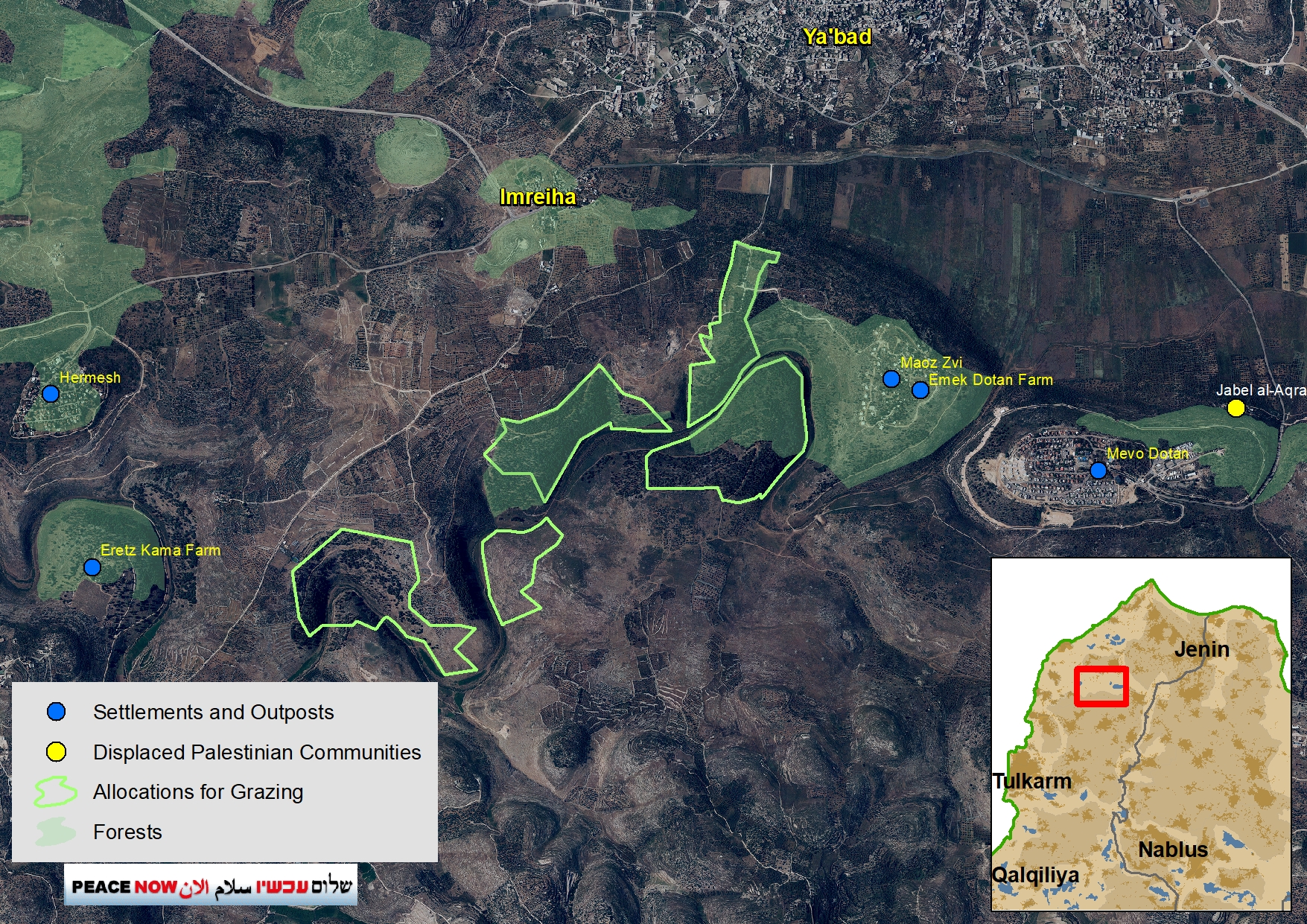
On November 1, 2026, a notice was published on the COGAT website regarding the allocation of 1,152 dunams on the lands of Ya’bad, Kafr Ra’i, and Arraba in the northern West Bank, adjacent to the settlement of Mevo Dotan and the outposts of Ma’oz Zvi and Emek Dotan Farm. Roughly half of the allocated grazing area lies within an official forest. In May 2025, the government decided to establish a new settlement in the area called “Ma’oz”—a move designed to retroactively legalize the illegal outpost of Ma’oz Zvi.
5. Allocation on Tubas Lands in the Jordan Valley (Vicinity of Menachem Goshen’s Farm)
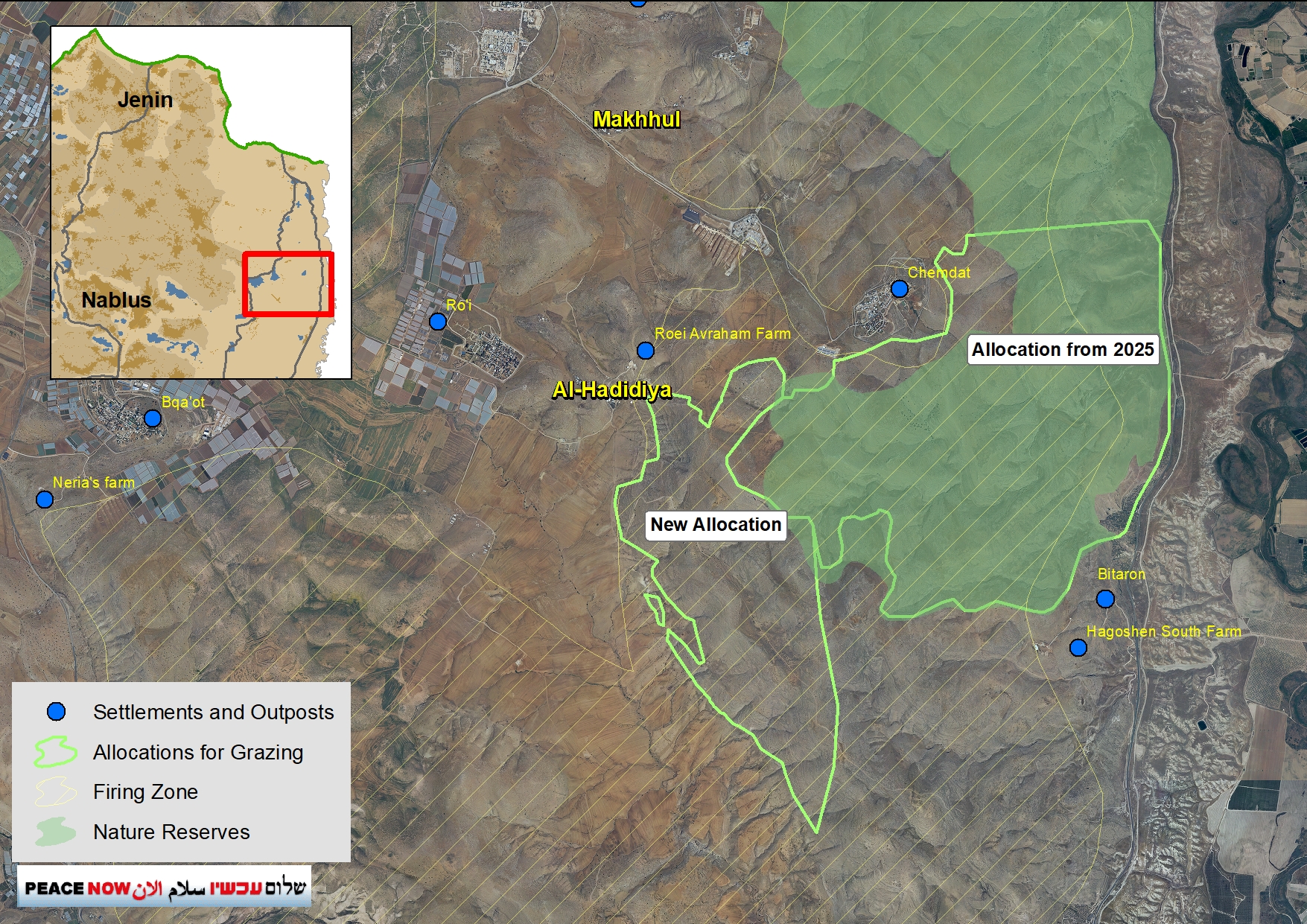
On November 9, 2026, an allocation of 4,038 dunams of Tubas land for grazing was published on the COGAT website. This allocation expands a massive grazing area already allocated in February 2025, bringing the total land handed over to settlers in the area to 12,772 dunams (three times the size of the city of Givatayim). The entire allocation lies inside a firing zone, with a nature reserve on its margins. It is located in close proximity to the homes of the Hadidiya community, whose residents suffer daily attacks and harassment from settlers in nearby outposts.
6. Allocation on Kafr Malik and Fasayil Lands (Malachei HaShalom Outpost Area)
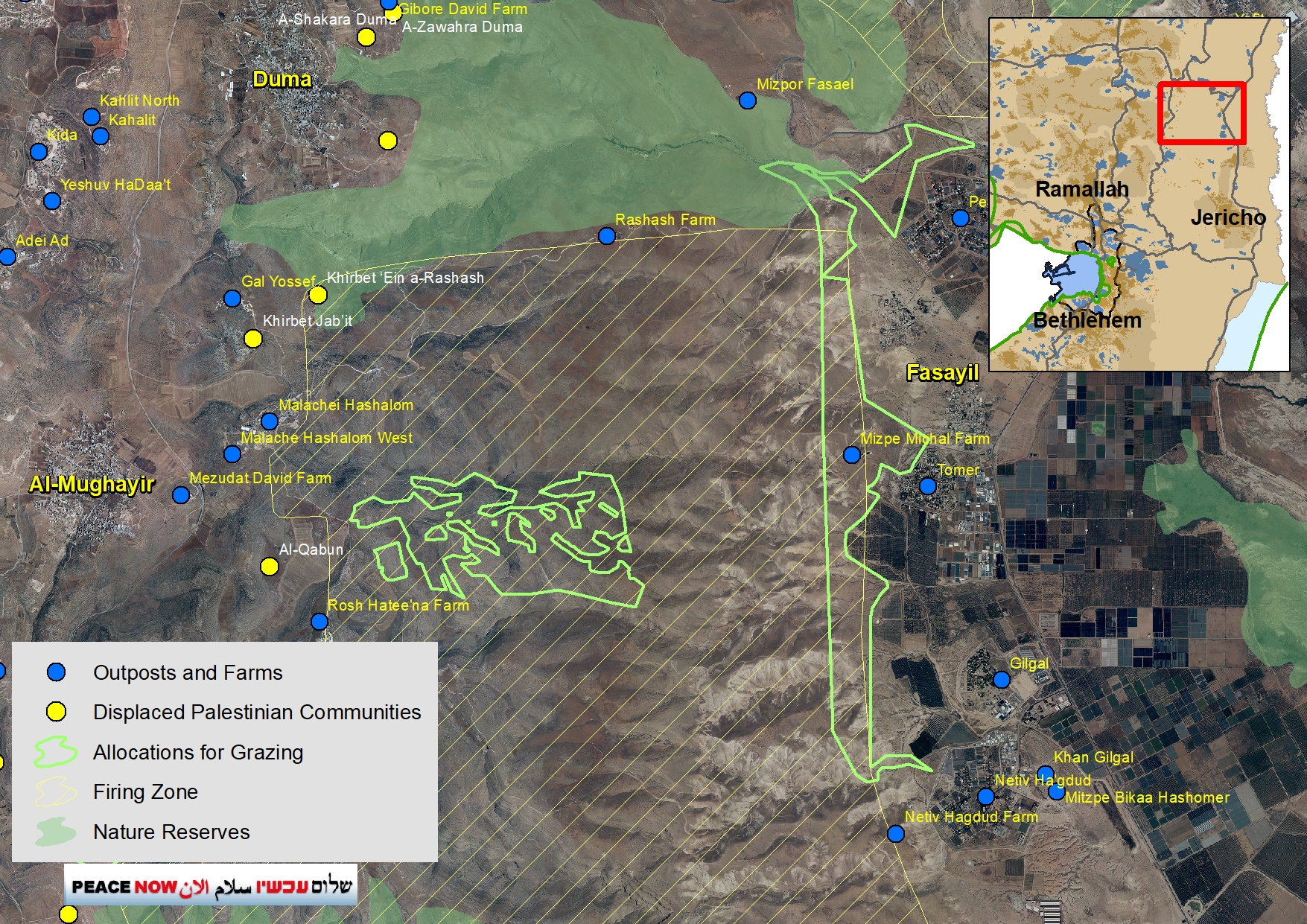
On November 10, 2026, a grazing allocation of 5,545 dunams, divided into two sections, was published in the daily press. The eastern section, on Fasayil lands (near the Mitzpe Michal Farm outpost), sits very close to the homes of the Palestinian village of Fasayil. The western section, on Kafr Malik lands, is located near several farming outposts linked to Eliav Libi’s Malachei HaShalom outpost and close to expelled Palestinian communities. Almost all of this allocation lies within a military firing zone and encroaches upon a nature reserve.
7. Allocation on Tayasir and Tubas Lands (Vicinity of Eitan Ze’ev and Yosef Haim Zion’s Tzvi Ofarim Outpost)
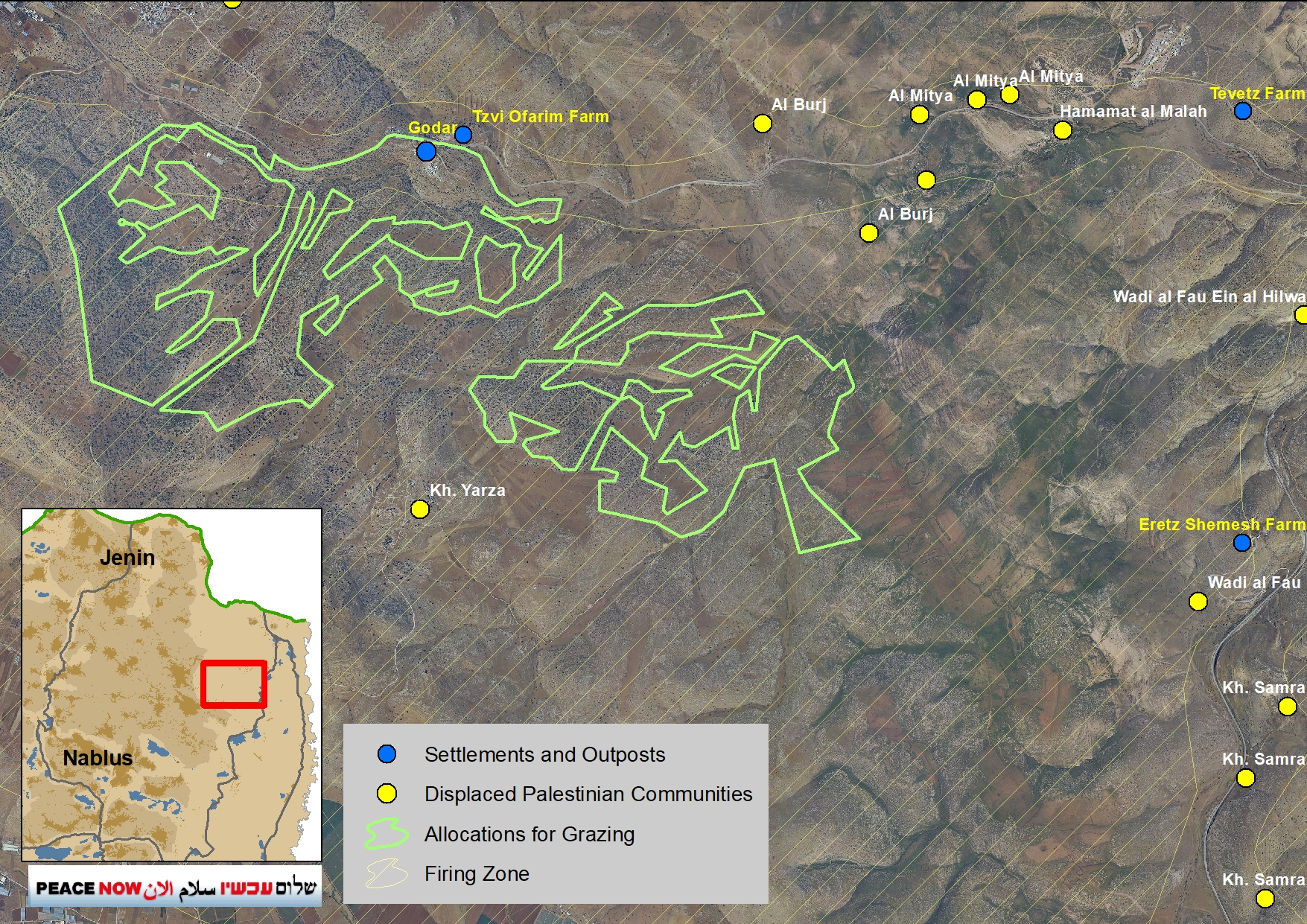
On November 13, 2026, a notice was published in the press regarding the allocation of 4,317 dunams of Tayasir and Tubas lands in the northern Jordan Valley for grazing. The allocated areas lie almost entirely within a military firing zone, near the outposts of Tzvi Ofarim Farm and Tevetz Farm, in a region from which numerous Palestinian communities have been expelled. Part of the allocated area is subject to a military seizure order for the construction of a Separation Barrier in the northern Jordan Valley.
8. Allocation Between the Villages of Abud and Al-Lubban al-Gharbiya – Between the Settlements of Beit Aryeh and Ofarim, Near Hananel Bartov’s Meir LaAretz Outpost
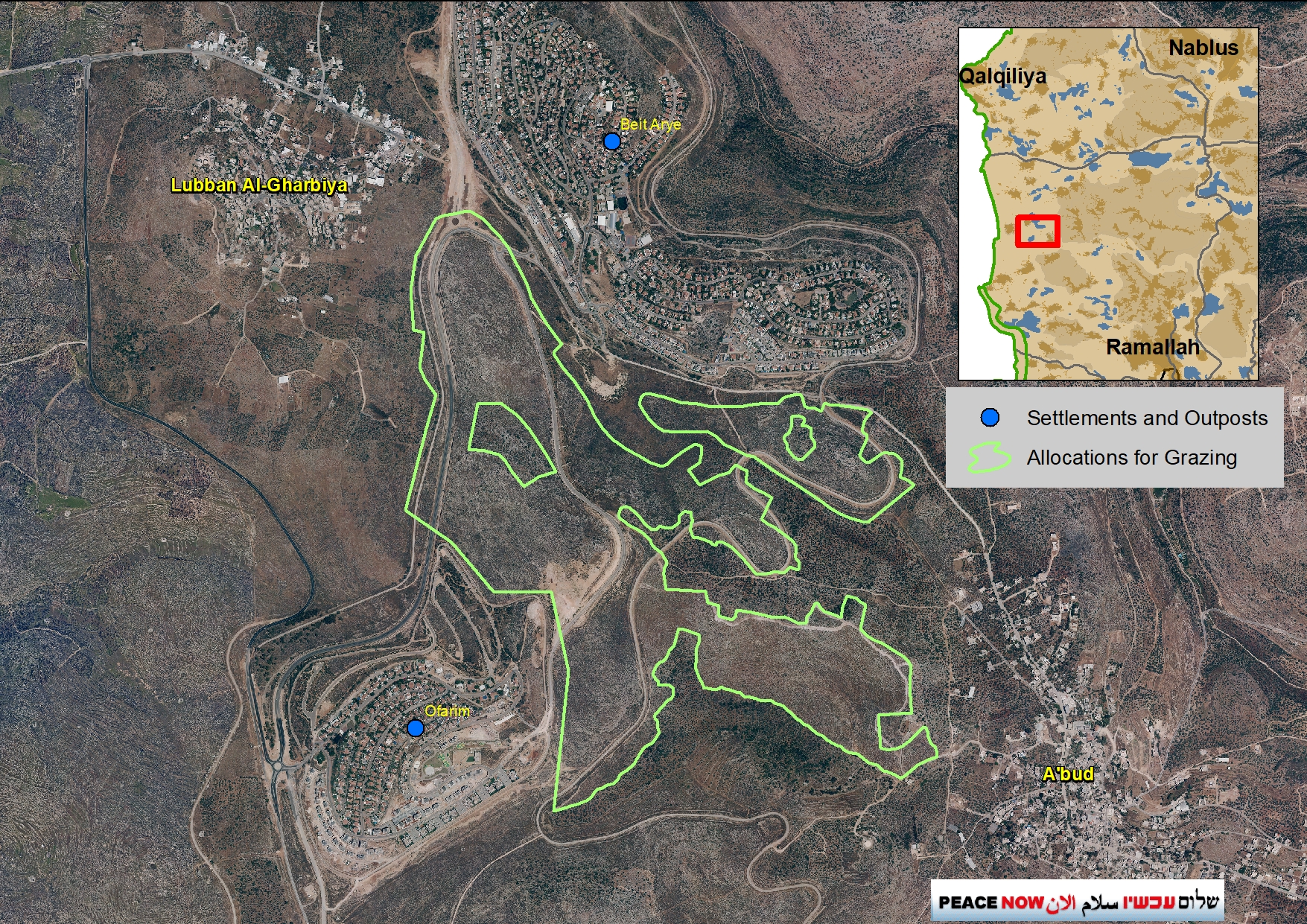
An additional allocation of 1,460 dunams covers lands situated between the settlements of Beit Aryeh and Ofarim, aimed at creating territorial contiguity between them.
9. Allocation for Water Reservoirs on the Lands of Ghor al-Far’a Near the Argaman Settlement
In early November, a notice was published in the press regarding the allocation of 584 dunams for the construction of two water reservoirs in the heart of the Jordan Valley. During a Higher Planning Council hearing to approve the construction plan for the reservoirs, it was stated that one is designed to hold one million cubic meters of water and the second 1.5 million cubic meters. The reservoirs are intended to ensure a continuous supply of water for irrigating date palm groves in the area, as well as additional orchards slated to be planted. The water is expected to be sourced from inside Israel from the Gan HaShlosha (Sachne) area and the Sea of Galilee.