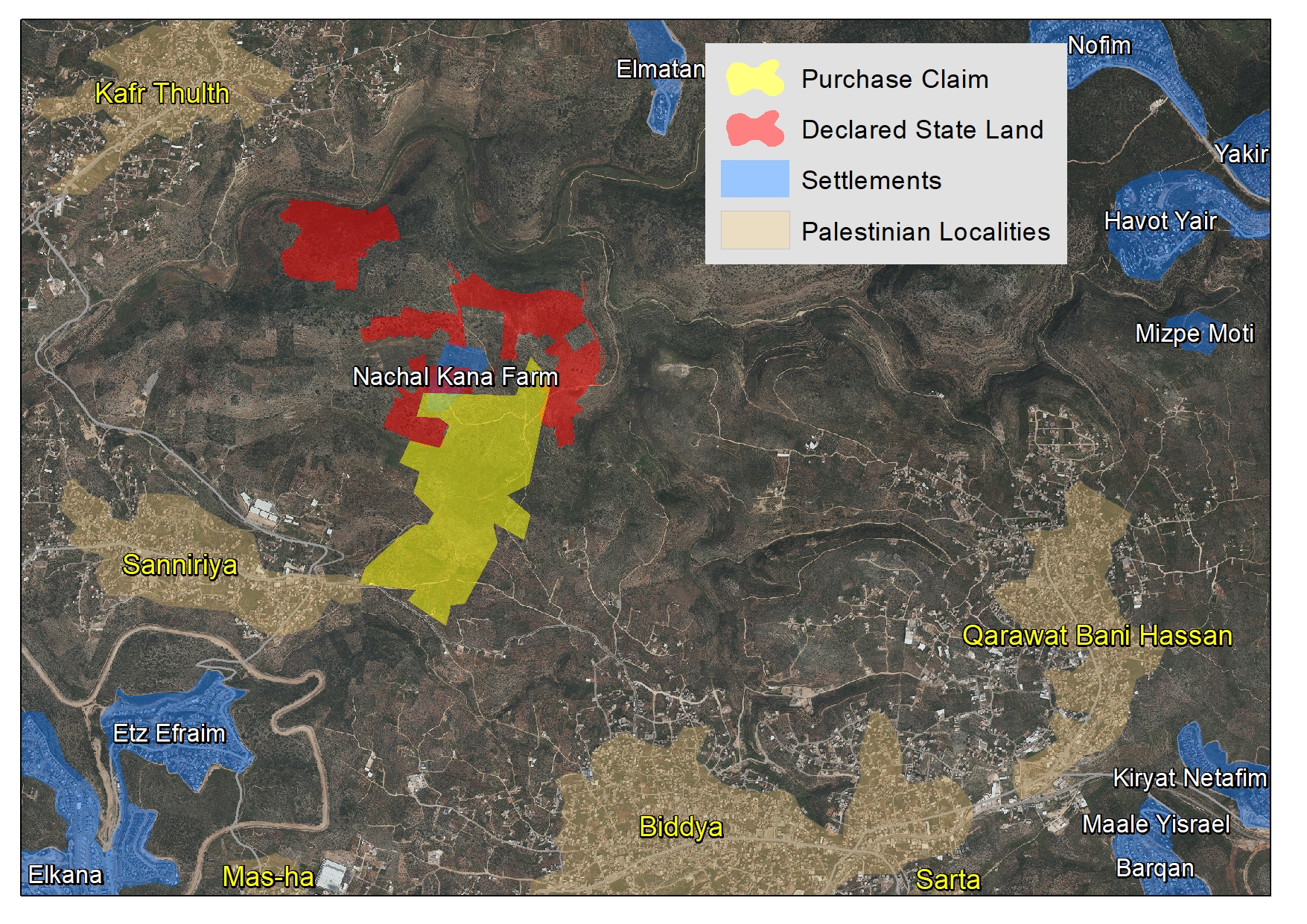
Last week, the Custodian of Government Property in Israel’s Civil Administration published a declaration designating 694 dunams of land belonging to the villages of Deir Istiya, Biddya and Kafr Thulth, adjacent to the Wadi Qana nature reserve, as “State Land.” The declaration complements an initiative by private Israeli developers who claim to have succeeded in purchasing about 200 dunams from Palestinians in the area and to be in the process of acquiring an additional 400 dunams. Together with the privately purchased plots, the newly declared “state land” could be used by the government to establish a new settlement in an area that constitutes the only remaining contiguous Palestinian territorial stretch east of Qalqilya.
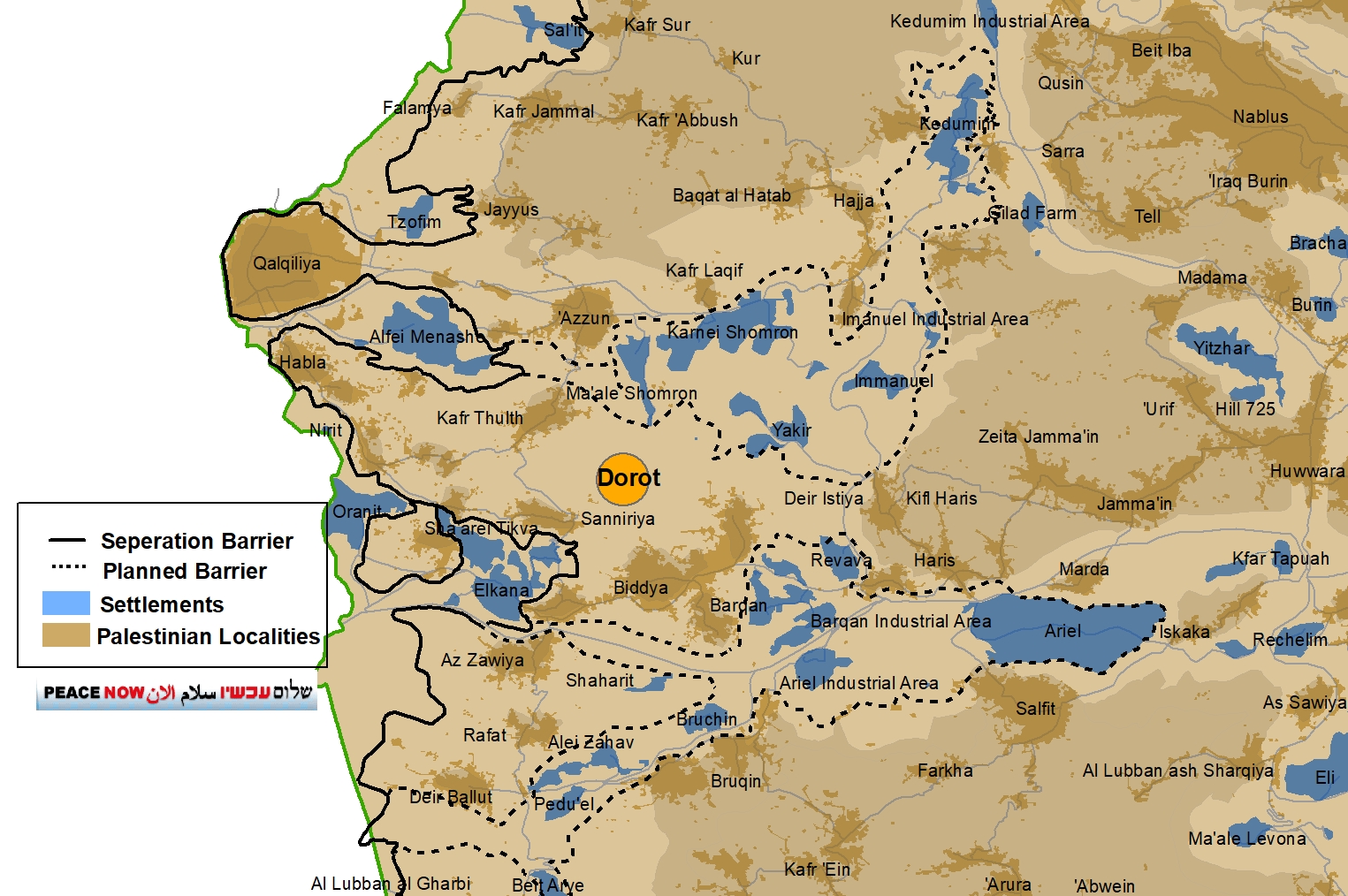
In 2020, an outpost known as Nahal Qana Farm (sometimes referred to as “Dorot Farm”) was established in the area and began exerting pressure on nearby Palestinian residents and farmers. Those operating the farm grazed cattle inside Palestinian orchards and cultivated fields and forcibly prevented Palestinians from accessing hundreds of dunams in the vicinity of the outpost.
In recent years, private developers have begun marketing building plots to the public for a future city called “Dorot Illit,” intended for the ultra-Orthodox community, despite the absence of a government decision to establish a settlement in the area or an approved construction plan. As part of the land marketing, the development company presents a rendering of the planned settlement that includes all nearby Israeli settlements, while the surrounding Palestinian villages are effectively erased and are absent from the promotional materials.
It has now emerged that the government is joining the settlement planning effort: the Civil Administration has labeled the land declaration adjacent to the developers’ holdings as “Dorot.” This is not the first settlement to be established at the initiative of private developers claiming to have purchased land from Palestinians. In February 2023, the government formally approved the establishment of the settlement of Mishmar Yehuda, where state land was likewise designated adjacent to plots acquired by developers. Other settlements established in a similar manner in the past include Modi’in Illit, Revava, Avnei Hefetz and others.
Peace Now: “Netanyahu and Smotrich are determined to fight the entire world and the interests of Israel’s citizens for the sake of a small group of settlers who are handed hundreds of dunams as a gift, as if there were no political conflict to resolve and no war to end. Today it is clear to everyone that this conflict cannot be resolved without a political agreement that includes the establishment of a Palestinian state in the West Bank, yet the Israeli government chooses to make matters harder and to push us further away from the possibility of peace and an end to bloodshed.”
Since the current government took office in December 2022, 26,653 dunams have been declared State Land—about half of all the land designated as state land since the Oslo Accords. Declaring land as state land is one of Israel’s primary methods for taking control of land in the occupied territories. Once land is declared state land, Israel no longer recognizes it as privately owned by Palestinians, who are barred from using it. At the same time, the state allocates state land exclusively to Israelis. During the 1980s, Israel declared hundreds of thousands of dunams as state land. In 1992, the Rabin government decided to halt such declarations in the territories, but the Netanyahu government resumed the practice in 1998. Over the past three years, there has been a sharp increase in the amount of land declared state land, and the government intends to carry out additional declarations to facilitate the establishment of new settlements approved by the cabinet.