

One week after the Higher Planning Council unilaterally assumed planning and building authority from the Palestinian Municipality of Hebron, the Council convened today and approved a building permit for the construction of a dormitory for settlers studying at the Shavei Hevron Yeshiva. The project will add two stories above a commercial building on Al-Shalalah Street, in the heart of Hebron’s historic market district (the Kasbah).
Peace Now: The government is racing toward annexation and apartheid. Hebron is the most extreme example of the regime Israel imposes in the West Bank, under which Israeli Jews enjoy rights while Palestinians are denied them. It is a city where entire streets are closed to Palestinians so that settlers can move through them freely. The decision to strip Palestinians of planning authority and to build a large new settlement compound in the heart of Hebron’s Kasbah is a microcosm of the annexation being implemented by the government—one that is condemning us to a future of conflict and bloodshed.
The building permit concerns a structure that settlers entered in September 2025 after the government decided to allocate it to the Shavei Hevron Yeshiva. The allocation effectively served as a form of “right of return” for property lost in 1948. The building, also known as Valero House, was owned by a Jewish family in the early twentieth century. In 1948, it was transferred to the administration of the Jordanian authorities, which leased it for use by Palestinians in Hebron. After 1967, all Jewish-owned properties in Hebron were transferred to Israeli administration under the Custodian of Government and Property in the Civil Administration, which continued leasing them for Palestinian use.
Following the 1994 massacre carried out by Baruch Goldstein against Palestinian worshippers at the Cave of the Patriarchs, the Israeli military closed shops, streets, and buildings to Palestinians in Hebron’s Old City. The Palestinian shops in Beit Valero were also shut down. In September 2025, the Custodian allocated the building to the Shavei Hevron Yeshiva, and the yeshiva has now received approval to construct two additional floors totaling 1,027 square meters.
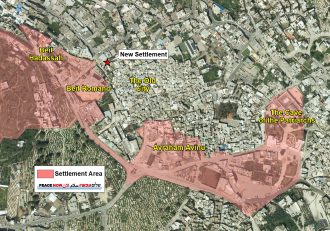
The location of the new construction approved by the HPC
Hebron is the largest Palestinian city in the West Bank after East Jerusalem, with approximately 250,000 Palestinian residents. Among them live around 1,000 Israeli settlers concentrated in the heart of the Old City. Planning and building authority in Hebron had been vested in the Palestinian Authority and the Palestinian Municipality of Hebron since the Hebron Protocol signed by Benjamin Netanyahu and Yasser Arafat in 1997.
Last week, the Higher Planning Council decided to assume planning and building authority in Hebron with regard to settler properties and a number of holy sites in the city. In doing so, it established a principle of ethnic separation under which planning for Israelis in Hebron will be carried out by the Israeli Civil Administration, while planning for Palestinians on the very same streets will remain under the jurisdiction of the Palestinian Municipality of Hebron.
A-Shalalah Street, where the dormitory is planned, has in recent years become the principal—and nearly the only—route used by Palestinians to access Hebron’s Old City and the Cave of the Patriarchs, following the closure of the parallel A-Shuhada Street to Palestinian traffic by the Israeli military. The expansion of the settlement at the Valero House raises concerns that the military may also close A-Shalala Street to Palestinians, citing the need to protect the settlement. Such a move would block Palestinians’ main access route to Hebron’s Old City.
For further information on the allocation of the Valero House to settlers, see here.