

About a week ago, Israel’s Ministry of Construction and Housing announced the signing of a development agreement for the Adam (Geva Binyamin) settlement, under which the government commits to investing NIS 120 million in infrastructure for construction and development in the settlement. According to the announcement, the agreement includes government funding for infrastructure to enable the construction of approximately 6,000 additional housing units in the settlement. In practice, however, the plan entails the establishment of a new neighborhood of Jerusalem, expanding the city for the first time since 1967 into the West Bank, without any territorial or functional connection between the area and the Adam settlement.
In October 2025, Plan No. 240/3 was submitted to the Higher Planning Council, proposing the construction of 2,970 housing units on roughly 500 dunams of land between the Palestinian communities of a-Ram and Hizma. Although the area lies outside Jerusalem’s municipal boundaries, the planned neighborhood (apparently intended for the ultra-Orthodox population) would function in every respect as a Jerusalem neighborhood and would form an integral continuation of the Neve Yaakov neighborhood.
Because formally expanding Jerusalem’s municipal boundary into the West Bank would constitute official annexation, the plan was designed to be classified as a “neighborhood” of the Adam settlement and, officially, not part of Jerusalem. In reality, however, there is no possible physical connection between the Adam settlement and the new settlement area, as they are separated by the separation barrier and an intercity road (Road 437).
Peace Now: This is the first time since 1967 that Jerusalem is being expanded into the West Bank. Under the guise of establishing a new settlement, the government is carrying out de facto annexation through the back door. The new settlement will function in every way as a neighborhood of Jerusalem, and its designation as a “neighborhood” of the Adam settlement is merely a pretext intended to conceal a move that effectively applies Israeli sovereignty to areas of the West Bank.
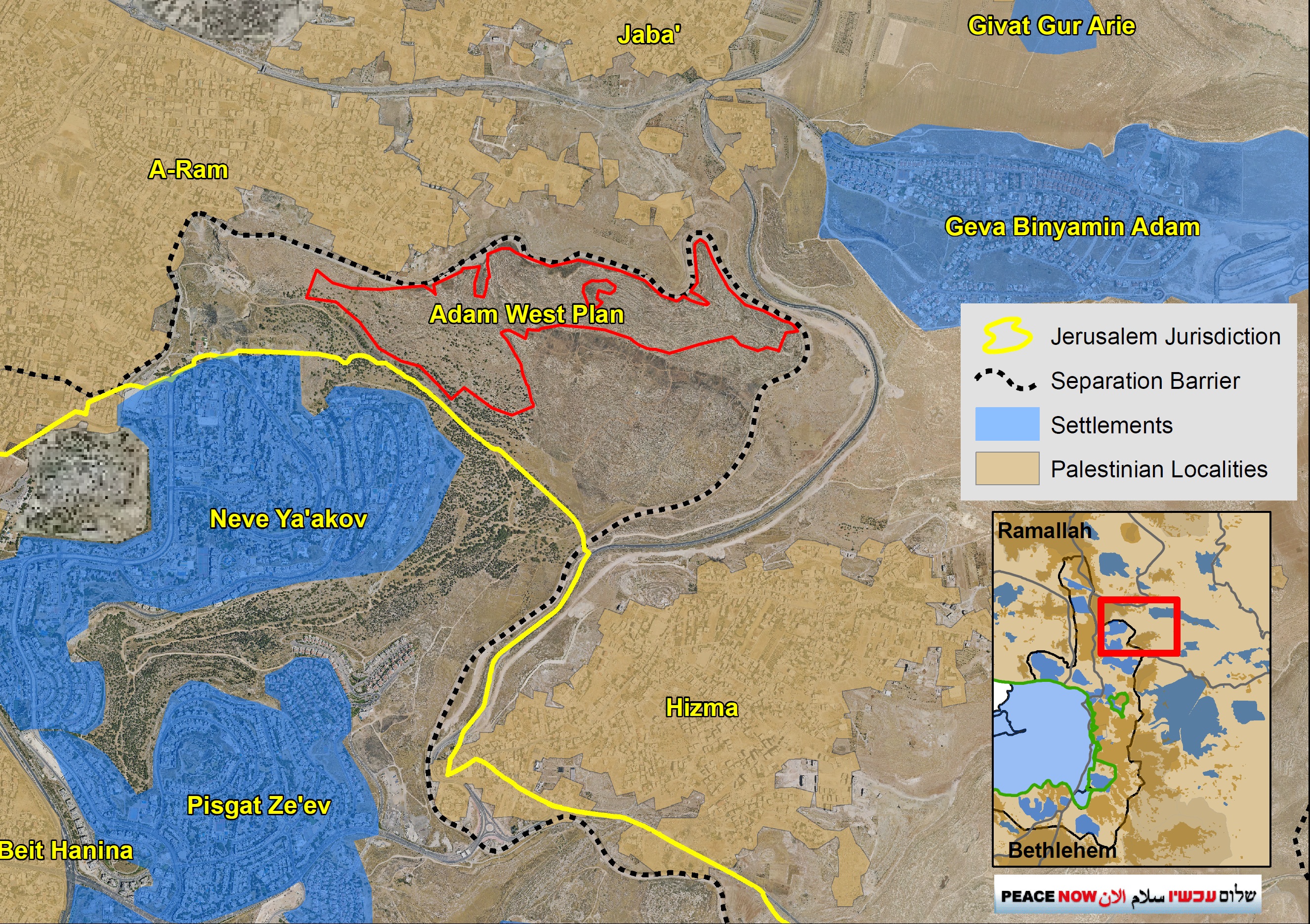
The submission of the plan to the Higher Planning Council indicates that it is complete and awaiting the scheduling of a discussion on approval for deposit, which is expected in the coming weeks or months. Planning procedures typically take between one and two years; however, given the government’s commitment to fund the infrastructure, there is a significant likelihood that the plan will be advanced rapidly and that construction could begin within two years.
When the separation barrier was built some 20 years ago, its route deviated eastward from Jerusalem’s municipal boundary in order to include an additional hill east of Neve Yaakov. At the time, the organizations B’Tselem and Bimkom exposed that the true reason for the barrier’s route was not security-related, but rather an outline plan, then still conceptual, to build a new Jerusalem neighborhood in this location. The government has now begun actively advancing that plan, which may become a reality on the ground in the coming years.
It should also be noted that recent efforts have been made to expand and develop the Adam settlement itself. Over the past five years, tenders have been issued for the construction of 1,089 housing units in Adam, and new plans have been approved for approximately 700 additional units. In December 2025, the Commander of the Central Command signed an order adding 1,107 dunams to the settlement’s jurisdiction to the east. This expansion will allow for the retroactive legalization of the illegal outpost Bnei Adam and the addition of thousands of housing units to the settlement.
In addition to these developments, several violent shepherd outposts have been established in recent years in the vicinity of the settlement. These outposts have led to the displacement of the Bariyet Hizma community and to numerous attacks against the nearby Bedouin community of Jaba’.